

Biscuit turned twelve in March. He is a Golden Retriever, about seventy-two pounds, and he has arthritis in both hips that our vet diagnosed roughly two years ago. The thing that got my attention last winter was not the limping. It was the sound. He would push himself up off the rug in the living room and there would be this slow scrape of nails on the hardwood while he worked out where to put his back legs. Cold mornings were worse. The first ten minutes after a long nap were worse. I started reading about omega-3 supplements the way people do at eleven at night, one tab at a time, and Zesty Paws kept showing up in the results.
I am not a veterinarian and I am not going to pretend to be one. I am a retired dental hygienist in Dayton, Ohio, with a two-story house, a carpeted staircase, and a back deck with three wooden steps down to the yard. Those three steps became my measuring stick. For about six months now, Biscuit has been getting the Zesty Paws Omega 3 chews with his breakfast, and I have kept loose notes on what changed, what did not, and what I would tell a neighbor who asked me straight out. This is that.
The Quick Verdict
A chicken-flavored soft chew with a real fish oil source behind it. Six months in, Biscuit gets up in one motion instead of two. It did not replace his medication and it will not replace yours.
Amazon Check Today's Price →If you are going to give it a fair trial, start with the 90-count bag
Ninety chews is the difference between a two-week experiment and a real three-month test. Check the label for the amount that fits your dog's weight, and run it past your vet before the first chew.
Amazon Check Today's Price on Amazon →How I've Used It
Biscuit gets his chew in the morning, right after his food, because that is when I am already standing at the counter with the bag open and a dish towel over my shoulder. The form is a soft chew, and the flavor is chicken, which matters more than I expected. He takes it straight out of my hand like a treat. I did not have to bury it in peanut butter or crush it over kibble, and after twelve years of hiding pills in cheese, that alone felt like a small mercy. I should be fair and say he is a food-motivated retriever. He is not a picky dog, so my experience is not the hardest test case out there.
Before the first one, I called our vet. I brought the bag in with me to his recheck and asked whether the amount printed on the label was appropriate for a dog his size, and whether it would interfere with anything he was already taking. She read the panel, said the amount on the label was fine for his weight, and told me to keep everything else exactly the same so we could actually tell whether it was helping. That last part is the advice I would pass on to anyone. Same food. Same walking route around the block. Same ramp into the back of the silver Honda CR-V. If you change four things in the same week, you learn nothing and you credit the wrong one.
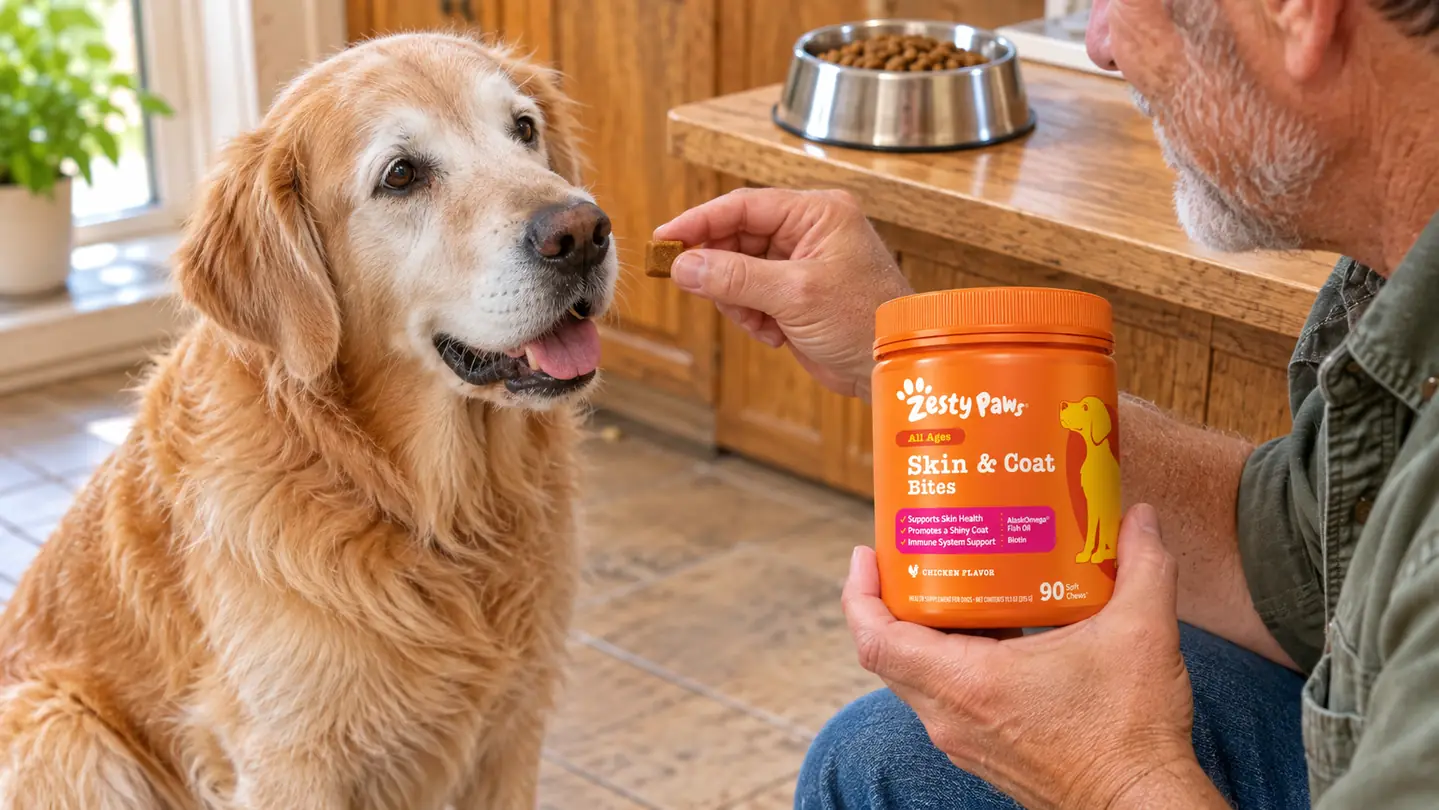
The Zesty Paws bag holds 90 chews. That is the number worth looking at, because depending on your dog's weight and what your vet tells you, you are looking at anywhere from about a month to a few months of supply. It is enough to get past the point where you are squinting at your dog and trying to remember whether he was stiffer last Tuesday. Six weeks is a reasonable first checkpoint for a joint supplement of any kind. Two weeks tells you nothing except whether your dog likes the taste.
What's Actually in the Chew
The omega source is the part I cared about most, so I read the panel closely. The main ingredient is AlaskOmega, which the listing says is derived from Wild Alaskan Pollock. Not salmon. Pollock. There is also DHA Gold, cod liver oil, ascorbic acid, D-alpha tocopherol, zinc, and biotin in the active ingredient list. The label groups the benefits as joint and hip support, heart health, immune support, and skin and coat, which is a wide net, and you should read it as a wide net rather than a promise about any single one of those.
One thing I would change if I could: the front of the bag does not spell out the exact milligram breakdown of EPA and DHA in plain numbers a person can compare at a glance. If you are the type who wants to line two products up side by side and see which one delivers more omega-3 per chew, you will be doing some digging. I am that type, and I did the digging, and I still ended up choosing on the strength of the ingredient sourcing more than on a tidy number.
The chews are grain free and the allergen information lists them as oat free, which mattered to me only because Biscuit's digestion is not adventurous and I did not want to introduce a new grain at the same time as a new oil. And here is the part people skip past: a soft chew is a treat. It has calories and it has flavoring. If your dog is on a weight program, which many older dogs with sore hips are, count the chew in the daily total instead of pretending it does not exist. Carrying extra weight is harder on a bad hip than almost anything else you can control.
What Changed Over Six Months
Month one, I could not tell you a single thing. I want to be clear about that, because the internet is full of people who report a turnaround in four days and I do not believe most of them. Weeks one through four looked exactly like every other month of his life. He got up slowly. He took the stairs one at a time with a pause at the landing. He slept a lot, which is normal for him, but he arranged himself carefully when he lay down, and that careful arrangement is the thing I was watching.
Sometime in the second month I noticed the deck steps. There are three of them, wooden, a little weathered, going down to the yard. For a couple of years Biscuit had been stopping on the middle one, not because he was tired, but because it seemed to take him a second to decide which leg went first. One evening in early spring he just went down in one continuous motion, nose to the grass, no pause. I stood at the top and did not say anything because I did not want to make it a thing. But I noticed. I wrote it on the calendar that night, which is the most scientific thing I did all year.
By month four the mornings had changed. The cold-morning routine used to be: he hears me moving, he lifts his head, he thinks about it, and then there is a slow gathering of himself before he stands. Now he stands, and then he thinks about it. It sounds like nothing written down. If you have an old dog, you know it is not nothing. The nail-scraping sound on the hardwood is shorter. He gets his feet under him faster. He still walks stiff for the first few minutes of the evening loop, and he always will, because that is what arthritis does.
What did not change is just as important. He still cannot jump into the back of the CR-V on his own, and I still use the ramp, and I expect I always will. He still pays for the long walk if I let him overdo it, so I do not let him overdo it. He still has bad days when the weather turns cold and wet, and on those days the chew is not doing anything visible. This is a supplement that supports a dog who is already being managed. It is not a replacement for the prescription medication our vet has him on, and I did not reduce that medication, and I would not have without asking her first.
Six months in, the visible result is that he takes the three steps down to the yard in one go instead of stopping halfway. That is the whole thing. Around here, at twelve, it counts.
The Daily Logistics Nobody Mentions
The smell is fish. I know that sounds obvious, and I am telling you anyway, because the bag lives in the cupboard next to his kibble and for the first week I could smell it every time I opened that cupboard door. It is a mild, clean fish smell, not a spoiled one, and I stopped noticing it after a while. If you are sensitive to fish oil, keep the bag in a container or move it somewhere with a door between it and your nose. The chews themselves are firm enough to hold together in your hand and soft enough that a twelve-year-old retriever with a couple of worn molars handles them without any drama.
My routine is boring and it works: chew in the morning with breakfast, walk in the evening, ramp in and out of the car, and a note on the calendar when I see something worth noting. I do not give it on an empty stomach, mostly because Biscuit has always been a dog who does better with food in him, and I did not want to introduce a variable at the same time as the supplement. If your dog has a sensitive stomach, that is worth mentioning to your vet when you ask about starting.
One practical thing I got wrong early on: I was watching for the wrong signal. I kept looking for him to bound across the yard, and he is never going to bound again, and that is not a failure of the chew, that is just being twelve. The signals that matter are smaller and duller. Less hesitation at the stairs. Fewer of those long pauses before he stands. Standing up without that little swing of his back end. Once I started looking at those instead, I could see what was happening.

Where These Chews Fall Short
The honest complaint is cost per day. A 90-count bag is a real purchase, and depending on your dog's weight you may go through it faster than you would like. Because the results are gradual and undramatic, you are paying consistently for something you cannot always point to on a given Tuesday. That is a bad combination for a household on a tight budget, and I would rather say so than pretend this is a painless line item. If money is tight, a plain liquid fish oil from your vet may stretch further, though you will be back to the peanut butter problem.
The second shortfall is that this is not a fix for the underlying problem. Arthritis does not reverse. My dog is not going to get younger, and no chew on the market changes that. What I bought was a modest improvement in how he moves through an ordinary day, and a modest improvement is what I got. If you are looking for a dog who stops limping entirely, you are going to be disappointed by this product and by most of the ones next to it on the shelf. Talk to your vet about the whole plan, including weight, exercise, and whatever they have prescribed, before you spend anything on supplements.
What I Liked
- Biscuit takes it as a treat, no hiding or crushing required
- AlaskOmega from Wild Alaskan Pollock is a clean, traceable omega source
- Grain free and oat free, which suited a dog with a settled but unadventurous stomach
- The 90-count bag is long enough for a real trial instead of a two-week guess
Where It Falls Short
- Gradual results, so you cannot judge it in a week
- Cost per day adds up on a large dog
- Fish smell is noticeable when you open the cupboard
- Not a substitute for prescription medication or weight management
Who This Is For
This is for the owner of an older dog who has already been to the vet, already has a diagnosis and a plan, and wants to add one sensible piece to it. It suits a dog who is slowing down in the ordinary ways: slower to rise, hesitant on stairs, stiff after a nap, careful about lying down. It suits a household that can commit to six weeks before making a judgment and can keep a rough note of what they see. And it suits a dog who will eat a chicken-flavored soft chew without a fight, which describes most retrievers and about half the terriers I have met.
Who Should Skip It
Skip it if your dog has not seen a vet about the stiffness yet. Limping is not always arthritis, and starting a supplement before you know what you are dealing with can hide something that needs attention. Skip it if your dog is a picky eater who turns his nose up at fish, because a supplement that goes uneaten is just an expensive bag in the cupboard. Skip it if your dog is already on a prescription omega-3 from your vet, since doubling up is a conversation, not a decision. And skip it if you are hoping this replaces the harder work of keeping weight off a sore dog, because it does not, and that work matters more than anything in the bag.
The stairs are the test. Give it six weeks and watch them.
Ninety chicken-flavored chews, one chew-sized decision each morning, and a calendar note when you see something. Ask your vet about the amount that fits your dog before you start.
Amazon Check Today's Price on Amazon →