
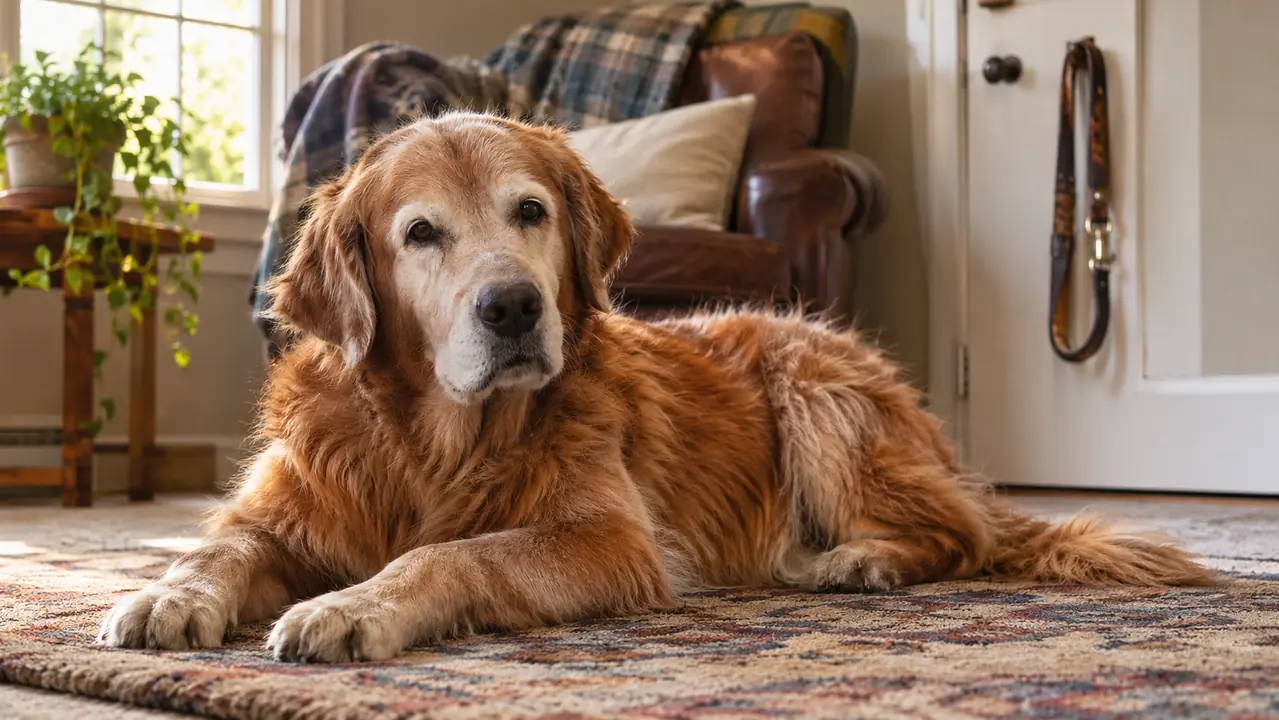
The part nobody mentions in a joint supplement review is the waiting. The first three weeks with Biscuit on Cosequin looked exactly like the three weeks before it. Same slow push up off the rug after a nap. Same pause at the top of the carpeted stairs while he decided whether the trip down was worth it. If I had judged the bottle on that stretch alone, I would have told you it was nothing and moved on. I did not. What follows is the honest version, written months later, including the parts that did not work and the one change I had to make in how I hand it to him.
My name is Gwen Arbogast. I am 61, retired from dental hygiene, and I live in a two-story house in Dayton, Ohio, with a 12-year-old Golden Retriever named Biscuit. He is about 72 pounds and has arthritis in both hips, diagnosed by our vet roughly two years ago. I have no stake in Nutramax Laboratories and no medical training. I am simply further down this road than some of you, and I remember wanting one plain account from a person who was not selling me anything.
The Quick Verdict
It got Biscuit up off the rug in one motion on most days and helped him finish his evening walk without stopping. It did not fix the stairs, the car, or the cold mornings, and I still do the rest of the work.
Amazon Check Today's Price →The bottle I reordered before the first one was empty
Cosequin is a chewable tablet from Nutramax Laboratories with glucosamine hydrochloride, sodium chondroitin sulfate, and MSM. Four months in, it is still on my kitchen counter, which is more than I can say for the last two things I tried.
Amazon Check Today's Price on Amazon →How I've Used It
The bottle lists directions by weight, and I am not going to hand you a number to copy. Our vet set Biscuit's amount, and yours should set yours. What I can describe is the routine around it, because the routine is where most people quit. I keep the bottle on the counter beside the coffee maker, not in a cupboard, because anything in a cupboard is forgotten by the second week. The tablet goes in with his morning meal, at the same time I take my own pill, and that is the whole system. One habit stacked on another.
The first month I kept a note on the fridge. Not a chart, just a line a day about how he got up, whether he finished the block, whether he hesitated on the three wooden steps down to the back deck. It was a magnetic grocery pad, the kind with a red line printed down the middle, and I wrote in pencil because pencil does not smear when the freezer door sweats in summer. Reading those lines back later is the only reason I trust my own memory about any of this. The first ten days are blank in the useful sense. Nothing to report, nothing to write down, no difference at all. I still have the page. March 4 reads 'slow, two tries, full block.' March 9 reads 'same.' It is a dull document, and that dullness is exactly what makes it worth keeping.
Somewhere in the fifth and sixth week the lines changed. Not dramatically. He stopped doing that little gather before standing, the one where he would rock back and then push. He just stood. I noticed it because I had been writing it down, and I would not have noticed it otherwise. That is the argument for the note on the fridge, and it is the argument against judging any of these bottles by how you feel on day nine.
One practical note. The tablets are chewable, which means you can also crumble one over food if your dog is the type who eats around pills. Biscuit is not that type. He eats around nothing. But I have had dogs who were, and crumbling is the option I would have used with them, mixed into a wet meal rather than dry.
The Tablet Itself, and the Small Daily Fight
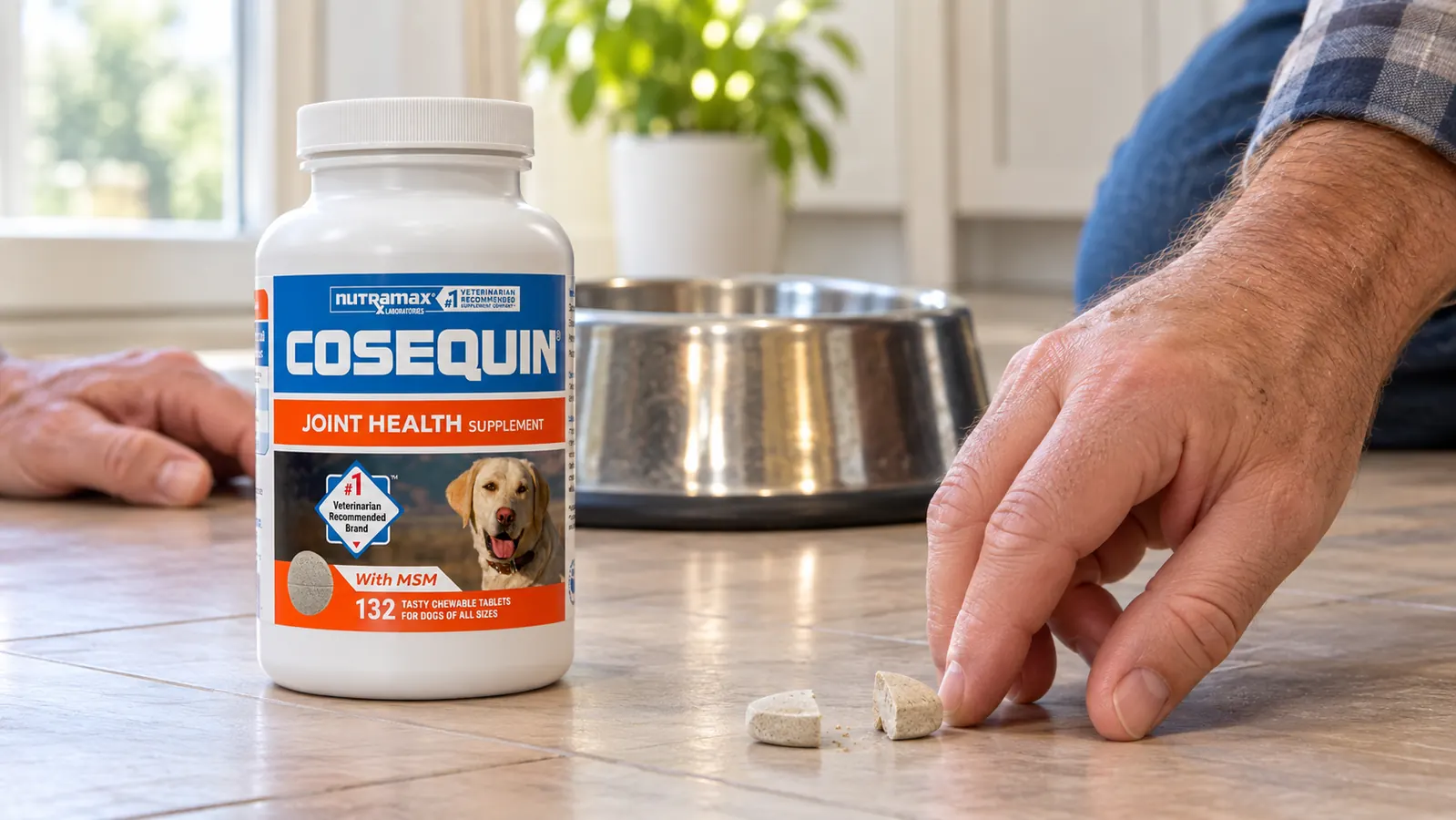
The tablets are chewable and they are not small. Biscuit is a 72-pound dog with a good appetite, and he still works one into three or four pieces before it goes down, which means crumbs on the floor and a Golden Retriever nose busy along the grout lines afterward. I break them in half now and he takes it faster. In the beginning I wrapped it in a piece of cheese. I stopped when I realized I was training him to expect cheese with every meal.
The first week I tried cheese. The second week I tried a smear of peanut butter on the back of a spoon, which worked right up until he licked the spoon clean and dropped the tablet on the floor. The third week I gave up on the theater entirely and put the tablet in his bowl with the kibble. He ate it. It took me three weeks to stop outsmarting a dog who was not being clever in the first place.
The bottle holds 132 chewable tablets. That number sounds generous on the product page and feels different in a real kitchen. It lasted us a reasonable stretch, and the only reason I noticed the count at all is that I ran out on a Sunday, which is the worst day to run out of anything. I have bought this bottle more than once. That is the real endorsement, more than a rating on a page.
Before you open it, read the label against whatever else your dog is taking. Cosequin has glucosamine hydrochloride, sodium chondroitin sulfate, and MSM in it, and if your dog is already on a joint chew with the same ingredients, you may be stacking them without realizing it. I brought the bottle to our vet and set it on the exam table. That conversation took four minutes and was worth more than every review I read, including this one.
The Two Changes I Actually Noticed
The first is the getting up. Biscuit naps hard, and before Cosequin the transition from asleep on the rug to standing was a whole event. Front legs first, then a pause, then a push from the back that sometimes failed and he would lie back down for another ten minutes. Now it is one motion most days. Not every day. Most. I started counting, because counting is what I do. Ten naps in a row in the second week of May, and he did the two-stage push on seven of them. Ten naps in a row the second week of June, and he did it on two. I am not a researcher and that is not data. It is a woman with a pencil and a grocery pad, and it is the best I have.
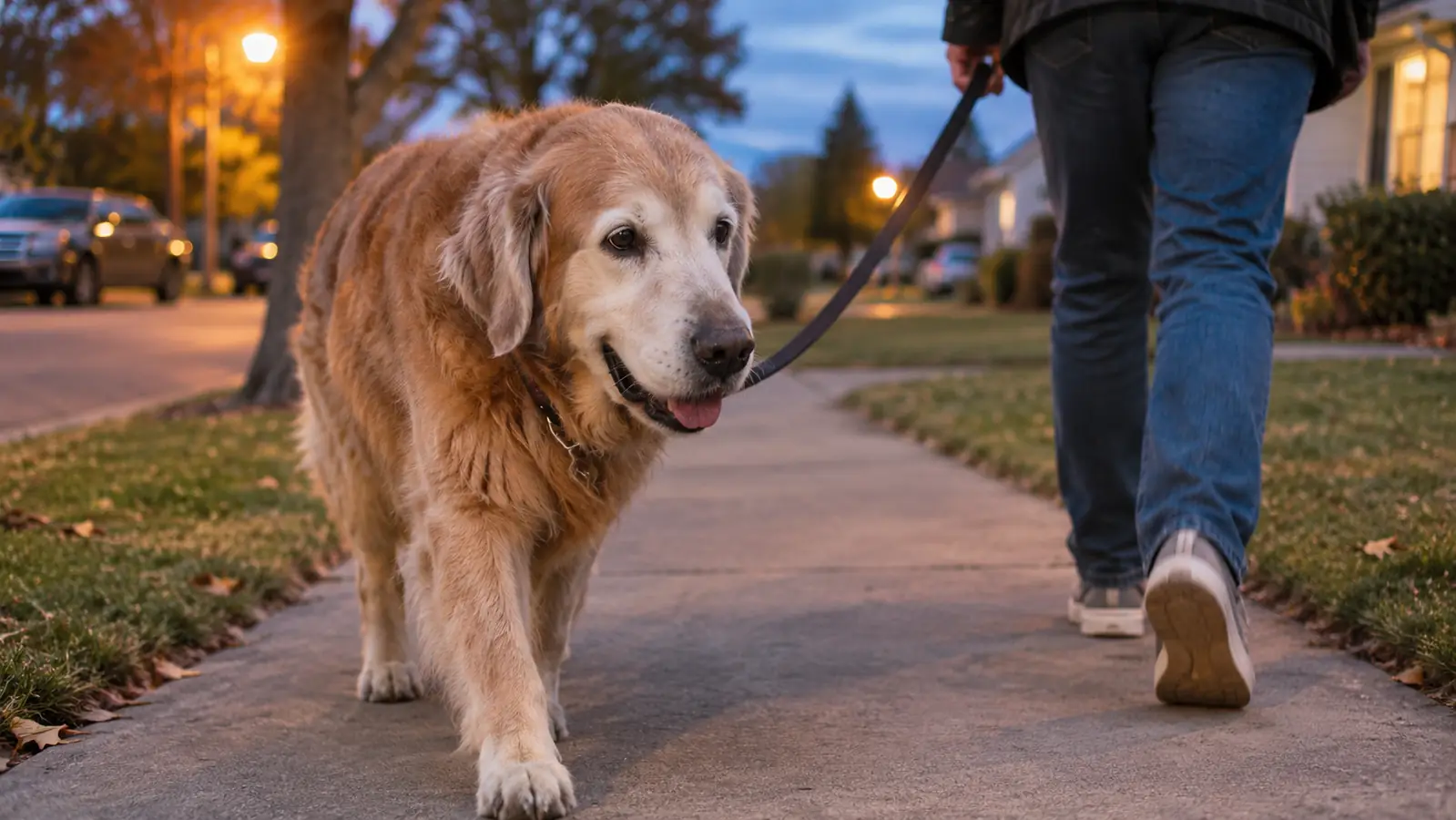
The second is the walk. Our evening loop around the block is a half mile and it has a slight rise in the middle that he used to stop on. He would stand at the top, look back at me, and I would turn us around early. He does not stop there anymore. He keeps going, and last month we added the longer loop on the far side of the neighborhood twice. I cried in the kitchen after the first one, which is an embarrassing thing to write down, but there it is.
That is the entire list. Faster up, further walking. His coat looks the same. His appetite is the same. His breath is the same. Anyone telling you a chewable tablet did more than this for a 12-year-old dog with hip arthritis is telling you a story, and I would ask them what they wrote down and when.
He does not stop at the top of the rise anymore. That is the whole review, honestly. Everything else is detail.
What It Did Not Do
It did not fix the stairs. Our house has a carpeted staircase and Biscuit sleeps upstairs with us, and he still takes it one step at a time with a hand steadying his harness. On a bad week he sleeps at the bottom of the stairs instead. Cosequin did not change that, and I do not expect it to.
It did not fix the car. I drive a silver Honda CR-V and Biscuit used to launch himself into the back without a thought. He cannot do that now. We use a folding ramp that lives in the back of the CR-V, folded flat, and setting it up takes about fifteen seconds. Fifteen seconds feels like a long time in a grocery store parking lot in the rain with a dog standing there getting wet and looking at you. I still do it, every time, including the times I am in a hurry and want to just lift him. Our vet was plain with me about the lifting, that a 72-pound dog who is not helping is a two-person job, and Biscuit has stopped being much help. A supplement does not put a 72-pound dog into a vehicle.
It did not fix the cold mornings. February in Dayton is a stiff, slow, unhappy month for him, and it was stiff and slow this year too. The furnace vent in the hallway is his spot from December through March, and on the worst mornings he goes out, does what he needs to do, and is back on that vent before I have my coat off. The difference is that the rest of the day recovers now. Last February he was still careful at two in the afternoon. This February, by nine, he was asking to go out again, which is his way of saying the day had started properly.
And it did not replace our vet. This is a supplement on a shelf, not a treatment plan. Biscuit still goes in twice a year, still gets his bloodwork, still has a weight we watch closely because every extra pound is a pound his hips carry. If your dog is limping suddenly, holding a leg up, or refusing food, that is a vet call, not a tablet.
The Two Weeks I Stopped, and What I Learned
In July I went to my sister's for eleven days and left Biscuit with my neighbor, who is kind and capable and who did not have a bottle of Cosequin in her kitchen. I did not think to send it. She has a ranch house with three steps at the front door and no staircase at all, which I assumed would be easier on him, and it probably was. What she does not have is a ramp, and she lifted him into her car once and felt bad about it afterward. He came home on a Sunday afternoon and walked from her driveway to my front door slower than he had walked in a month. It took about two weeks back on the routine before he was where he had been. I am not going to tell you that proves anything. Eleven days is not a study. But I take the bottle with me now, in a zip bag, and I put it in the first bag I pack, before the phone charger.
That is also the honest answer to whether this is a forever thing for us. It seems to be, for now. Biscuit is twelve. I am not running a long experiment. I am trying to keep an old dog comfortable, and Nutramax Laboratories is what we landed on, and it stays on the counter until our vet tells me otherwise.
What Is Actually in the Bottle
I read the label the way I read everything now, which is slowly, with reading glasses, and with a search engine open. The ingredients listed are glucosamine hydrochloride, sodium chondroitin sulfate, and MSM. The listing gives the glucosamine a name, FCHG49, and the chondroitin a name, TRH122, which are the company's own names for its raw ingredients. I will be honest, I do not know what to do with that information beyond noting that they name them specifically instead of lumping them together under one word.
What I can tell you is what Nutramax Laboratories says about itself, which is that it has been in pet health for more than 25 years and that Cosequin is described as the number one vet recommended retail joint health supplement brand. I cannot verify either claim from my kitchen, so I am handing them to you with a label on them: this is what the company says. What I can verify is that our vet did not flinch when I set the bottle down, and that is worth something.
The product page says the tablet form suits small, medium, and large dogs, and the same listing also files breed size as medium, which is the kind of contradiction you find on every product page ever written. Biscuit is 72 pounds and sits in the middle of that range. I would not guess at the edges of it. Ask before you buy for a 12-pound dog or a 130-pound one.
What I Liked
- Biscuit stands up in one motion most days now, up from a two-stage push that sometimes failed
- He finishes the half-mile evening loop and has added a longer route twice in the last month
- Chewable tablet, so no pill pocket gymnastics for a dog who eats anything anyway
- The 132-count bottle means I am not reordering every ten days
- Named ingredients on the label: glucosamine hydrochloride, sodium chondroitin sulfate, and MSM
- Still on my counter four months later, which is the only proof I trust from myself
Where It Falls Short
- The tablets are large and he crumbles them, which means crumbs on the kitchen floor
- Nothing changed in the first three weeks and I nearly quit
- It did nothing for the stairs, the car, or the cold mornings
- It is a supplement, not a treatment, and it does not replace a vet visit
- You have to keep the routine going, and travel is when I got lazy about it
Who This Is For
This is for the owner of an older dog who is not in crisis but is visibly slowing. The dog who still wants the walk and takes longer to get to the door. The one who does the two-stage stand after a nap and hesitates at the top of a step. The one whose stiffness shows up worst on cold mornings and after long naps, and who is otherwise still himself. If you are willing to give it eight weeks before you decide, keep a note on the fridge, and keep doing all the other things, this is a reasonable bottle to put on your counter.
Who Should Skip It
Skip it if your dog is limping, yelping, dragging a leg, or has stopped eating. That is a different problem and it needs a vet, not a chewable tablet. Skip it if your dog is already on a joint supplement built on the same three ingredients, because stacking them is how people end up giving twice what they think they are giving. Skip it if you want a fast answer. This one took weeks to show me anything, and I only caught it because I wrote it down. And skip it if you are not going to do the rest of it, the weight management, the ramp into the car, the steady hand on the stairs. The tablet is one part of this, and it is not the biggest part.
Four months in, this is still the bottle on my counter
If you are at the point where the get-up after a nap has become an event, this is the chewable tablet I kept buying. Ask your vet first, the way I did. Then give it eight weeks and keep a note on the fridge so you are not relying on memory.
Amazon Check Today's Price on Amazon →