
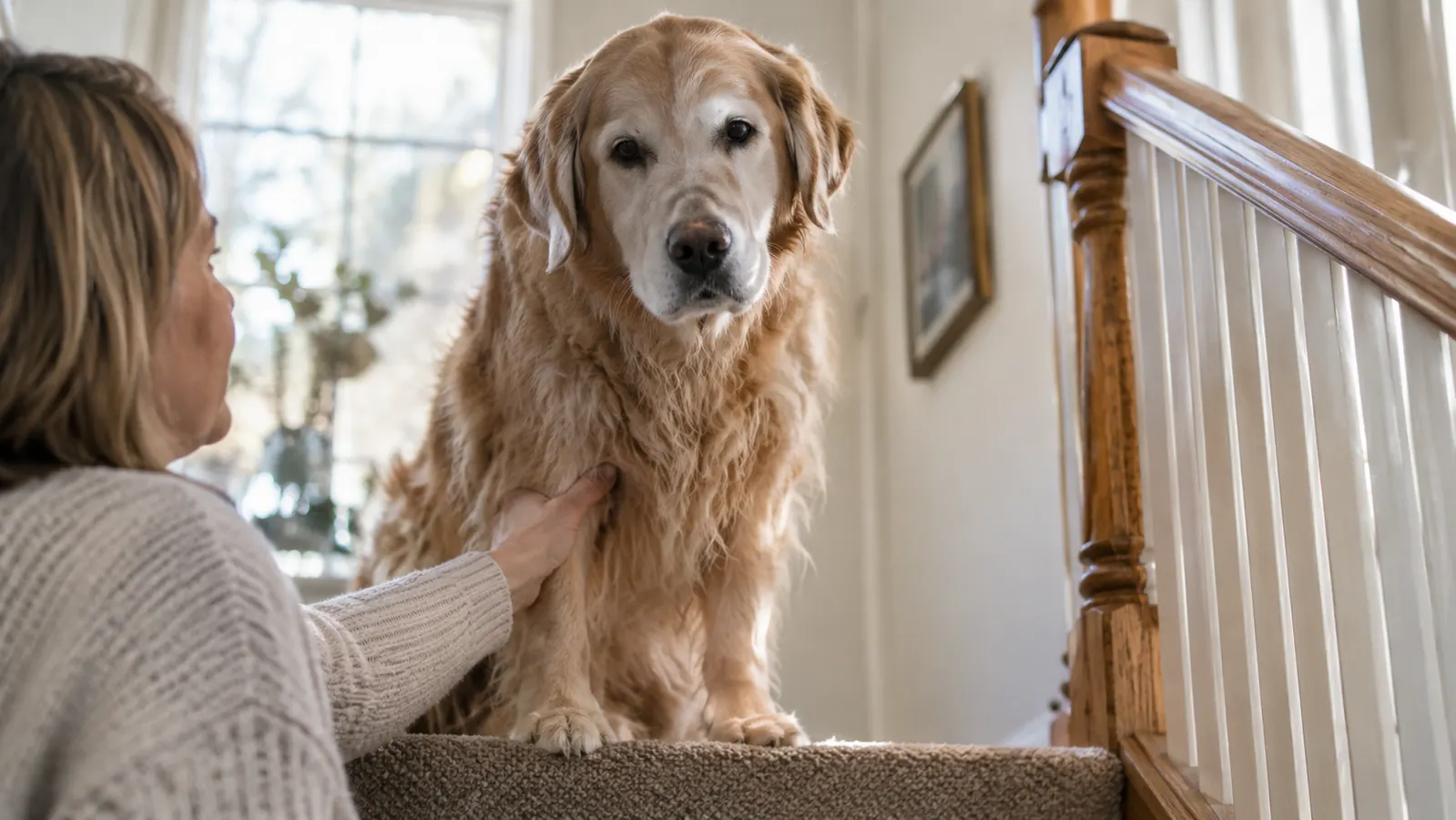
Biscuit is twelve, a seventy-two-pound Golden Retriever with arthritis in both hips, and the first ten minutes of his day tell me more than anything he does later. On a cold morning he stands at the top of our carpeted staircase and looks down at the steps as if he is calculating a bill. He does the same thing at the back door before the three wooden steps down to the yard. I spent a year trying to make those mornings easier with guesswork, buying beds he ignored and trying to rush him through a routine he clearly hated. The changes that helped were smaller and more boring than I expected.
One of those changes was adding a joint-focused omega-3 chew. I keep a container of Zesty Paws Omega 3 Fish Oil for Dogs on the kitchen counter, next to the coffee can, because if it is not in sight I forget it. This is not a story about a cure. Biscuit still has arthritis. Our vet diagnosed it about two years ago and has been clear that supplements are support, not treatment. But consistency and a few routine adjustments have made our mornings less of a negotiation. Check with your vet before you start anything, especially if your dog takes medication or has another health condition.
The First Change Was the Chew I Could Actually Remember to Give
A chicken-flavored soft chew is not going to fix an arthritic hip. It is one part of a morning routine, and it only works if your dog will take it and you will remember it. Zesty Paws makes a 90 count container that sits on my counter without taking over the kitchen. If you are already overwhelmed by a cabinet full of half-used bottles, start with one thing you can repeat.
Amazon See the Chicken Chew on Amazon →Step 1: Get a Vet Check Before You Change Anything
Morning stiffness can look like arthritis and be something else. Our vet diagnosed Biscuit's hip arthritis about two years ago after I described the slow rise, the bunny hop on the stairs, and the way he would stand still for a few seconds before walking. That appointment gave us a baseline, and it also ruled out things I would not have known to check. If your dog is new to you, or if the stiffness came on fast, or if he is dragging a back foot, start with the vet instead of the supplement aisle.
Ask what to expect from a supplement and what signs would mean you should stop. I am not a vet and I do not give dosing advice beyond the label. I asked our vet whether an omega-3 chew was reasonable for Biscuit, given his weight and his other medications, and I followed the amount printed on the container. That is the only dosing instruction I use. If your vet says no, or says wait, listen. A supplement is not a substitute for pain control, weight management, or a diagnosis.
I also wrote down the questions I wanted to ask before the appointment, because I forget half of them once I am in the room. The list included: is this arthritis or something else, what signs mean we need to come back, and is an omega-3 chew safe with his current medications. The vet answered all three and wrote them down for me. That piece of paper was more useful than any product label.
Step 2: Warm the Joints Before the Stairs
The staircase is where I see the stiffness most. Biscuit sleeps upstairs with us, and on a cold morning his back legs are stiff before he has taken ten steps. I started giving him a few minutes of slow movement before he has to face the stairs. I walk him to the top landing, let him stretch, and rub his hips with a flat hand, not a deep massage. Then I put his harness on and we take the stairs one at a time, with me on the downhill side. It is not a training exercise. It is a way to keep him from rushing because I am rushing.
On the worst mornings I carry him down. He is seventy-two pounds, so this is not something I do casually, and I only do it when he refuses the first step. The point is not to force a stretch or a walk. The point is to give the joints a little time before they have to work. A warm hallway and a slow start are cheaper than a fall, and a fall is the thing I worry about most on those steps. If your dog is too heavy to carry safely, ask your vet about a harness with a handle or a ramp.
A ramp might be the right answer for your house. It was not for ours, because the three back steps are shallow and Biscuit hated the ramp I borrowed. He would rather take them slowly with me beside him. That is the whole trick with an older dog. You are not training for a competition. You are trying to get to the kitchen without a slip.
Step 3: Make the Omega-3 Chew Part of a Routine You Already Have
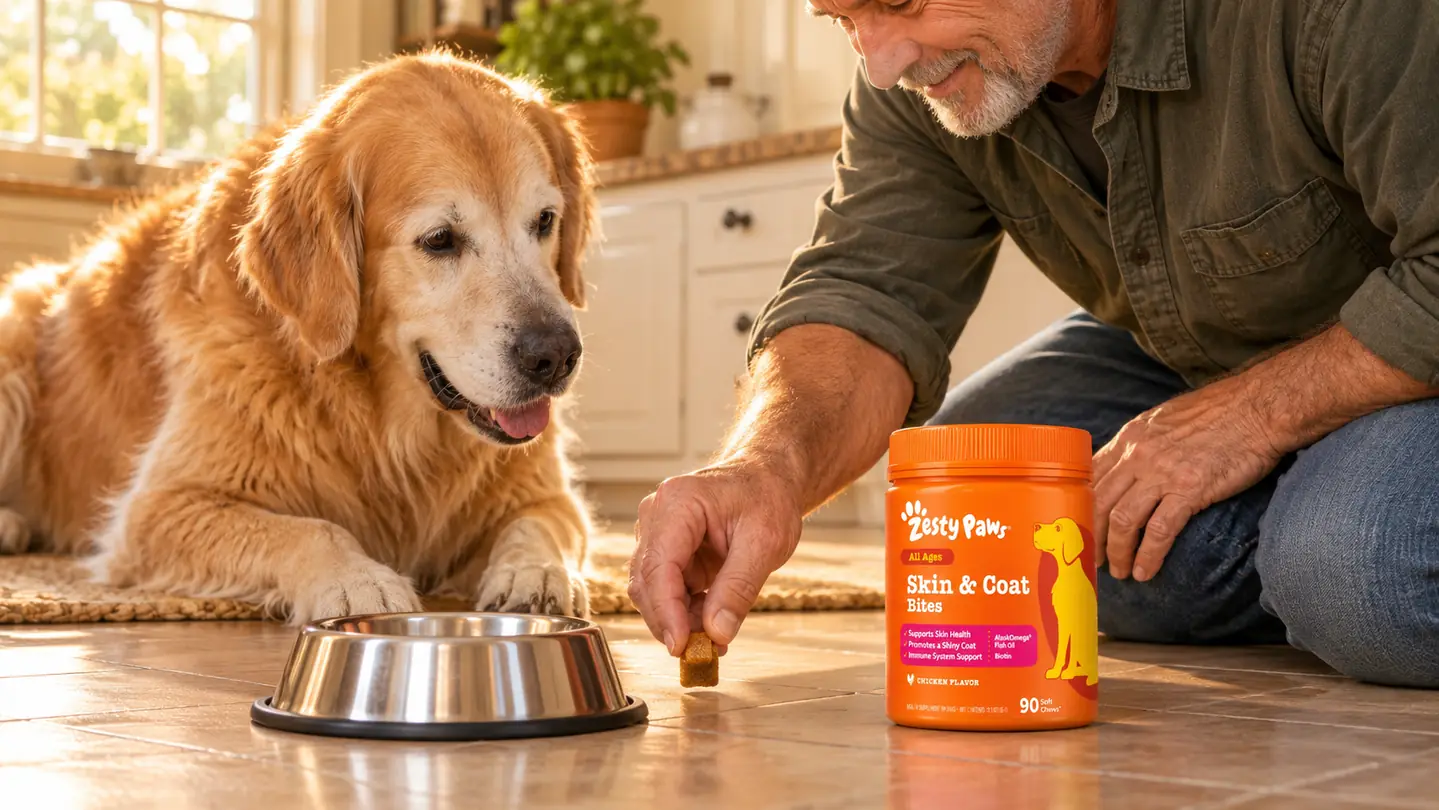
I tried adding a supplement at a random time and forgot it within a week. What worked was attaching it to something I already do. Biscuit gets his chews after his breakfast, while I am still standing at the counter with my coffee. The container is 3.5 x 3.5 x 4 inches and weighs 8 ounces, so it fits beside the coffee can without crowding the counter. That sounds like a small thing. It is the reason the routine lasted. If the container is in a cupboard behind the flour, the routine is already over.
The Zesty Paws container I buy is a chicken-flavored soft chew, 90 count, and the label says grain free. The chews are designed to support hip and joint health, immune system function, and skin and coat, and the omega fatty acids include EPA and DHA. The label lists AlaskOmega, which the package describes as derived from Wild Alaskan Pollock, along with DHA Gold, cod liver oil, ascorbic acid, D-alpha tocopherol, zinc, and biotin. I read that list out loud to our vet's office before I started. They did not promise anything, and neither will I.
What I watch for is not a dramatic change. I watch whether Biscuit takes the chew without turning his head away, whether his stool stays normal, and whether he is still willing to go for his short evening walk. If he refused the chew or seemed off, I would stop and call our vet. The label and the vet are the two authorities here, not a blog post. I also do not double up on fish oil products without asking, because more is not automatically better. A second product with overlapping ingredients is a question for the vet, not a do-it-yourself upgrade.
One thing I did not do: I did not stop his other arthritis care. The chew is an addition, not a replacement. Biscuit still takes what our vet prescribed, and we still go in for checkups. If you are tempted to drop a medication because a supplement seems to be helping, call the vet before you do. That is not a decision to make from a kitchen counter.
Step 4: Keep a Simple Morning Log for Two Weeks
You will not remember the details accurately, and neither will I. I wrote down four things each morning for two weeks: how long it took Biscuit to rise, whether he took the stairs without a pause, whether he finished his breakfast, and whether he took the chew. That is it. No app, no chart on the refrigerator, no complicated score. A note on the back of the grocery list was enough. The point is to see a pattern without turning your dog into a science project.
The log showed me something I had missed. Biscuit was not worse on every cold morning. He was worse on the mornings after I had been away at the store for three hours and he had slept on the hard kitchen floor instead of his bed. The chew was consistent, but the sleeping spot was not. If I had only watched for a big change from the supplement, I would have blamed the wrong thing. A log is not glamorous. It is the difference between a guess and a decision.
Step 5: Change the Rest of the Day Around What the Log Tells You
Morning stiffness is often a report on the night before. If your dog sleeps on a hard floor, put a bed in that spot. If the stairs are slippery, add a runner. If the car ride is the problem, help him in and out instead of letting him jump. Biscuit cannot jump into the back of our silver Honda CR-V on his own anymore, so I park close to the door and let him step out at his own pace. None of this is a cure. It is the difference between asking an arthritic hip to do too much and asking it to do a little less.
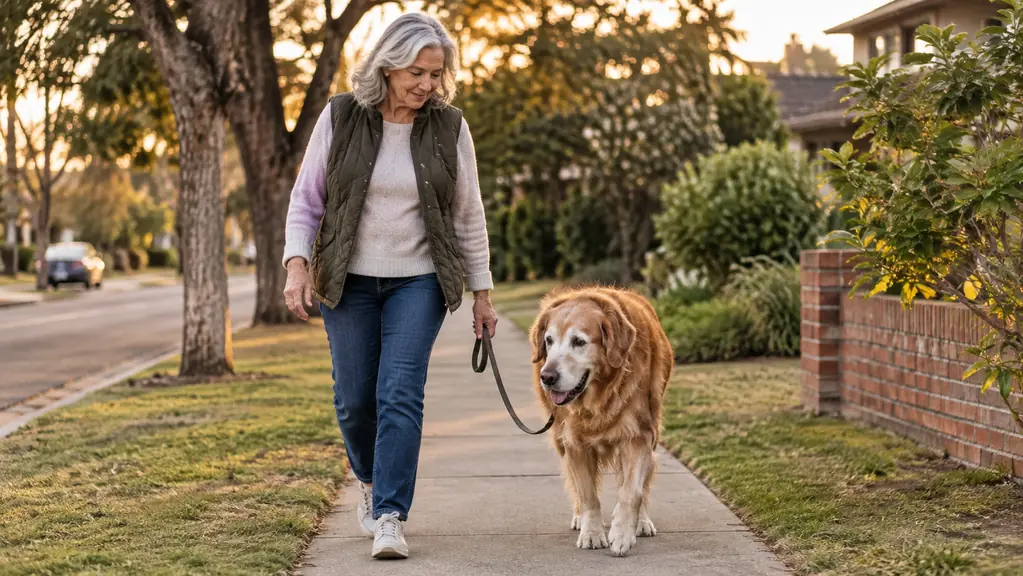
I also moved his evening walk earlier in the winter, while the sidewalk still had some warmth and before the temperature dropped. It is the same short walk around the block. He still gets to sniff the same bushes and mark the same corner. The walk is not exercise for weight loss. It is the part of the day he still loves, and I want to keep it that way. If your dog is limping or seems sore after a walk, that is a vet conversation, not a reason to push through. The goal is the next morning, not a personal record.
One more thing I changed: I stopped letting Biscuit follow me up and down the stairs all day. He used to trail me to the laundry room and back because he wanted to be where I was. Now I close the gate at the top of the stairs when I am doing chores and bring his bed to the landing. He can still see me from the landing, and he is not doing six extra flights a day on hips that already hurt. That was harder on me than on him. I like his company. I also like seeing him walk without a pause.
The useful change was not dramatic. It was that Biscuit stopped hesitating at the top of the carpeted stairs.
What Else Helps
Warmth, traction, and a little patience go a long way. I put a bath mat at the bottom of the back steps so Biscuit has something to land on that is not bare wood. I keep his nails trimmed because long nails change how a dog stands. I feed him at the same time every day and keep his weight steady, because extra weight is extra load on arthritic hips. Our vet has been the one to set the weight target, not me. If you are not sure what your dog should weigh, that is a question for the clinic, not for an online calculator.
Sleep is the other half of this. A dog who is stiff in the morning is often a dog who slept in one position on a hard surface. I put an orthopedic bed in the bedroom and a second one in the living room, because Biscuit follows the sun and I got tired of moving one bed twice a day. The beds are not a medical device. They are just a softer place to land. If your dog will not use a bed, a folded quilt on the floor is better than bare tile. The point is to give the joints a break at night, not to buy the most elaborate bed in the catalog.
If you want to try an omega-3 chew, treat it as one piece of a larger routine. Zesty Paws is the one I use because Biscuit will take the chicken-flavored soft chew and I can buy it in a 90 count container that lasts through a month of mornings. That is a practical reason, not a medical one. The medical questions belong to your vet. The routine questions, the log, the warm start, the runner on the stairs, those are yours to manage. Keep the routine small enough that you can still do it on a morning when you are tired and the dog is stiff and nobody wants to be awake.
Start With a Morning You Can Repeat
A chew only helps if it becomes part of the day. Put the container where you will see it, follow the label, and keep the rest of the routine simple enough to repeat on a bad morning. If your dog is already on medication or has a health condition, call your vet first.
Amazon Check the Current Options on Amazon →