
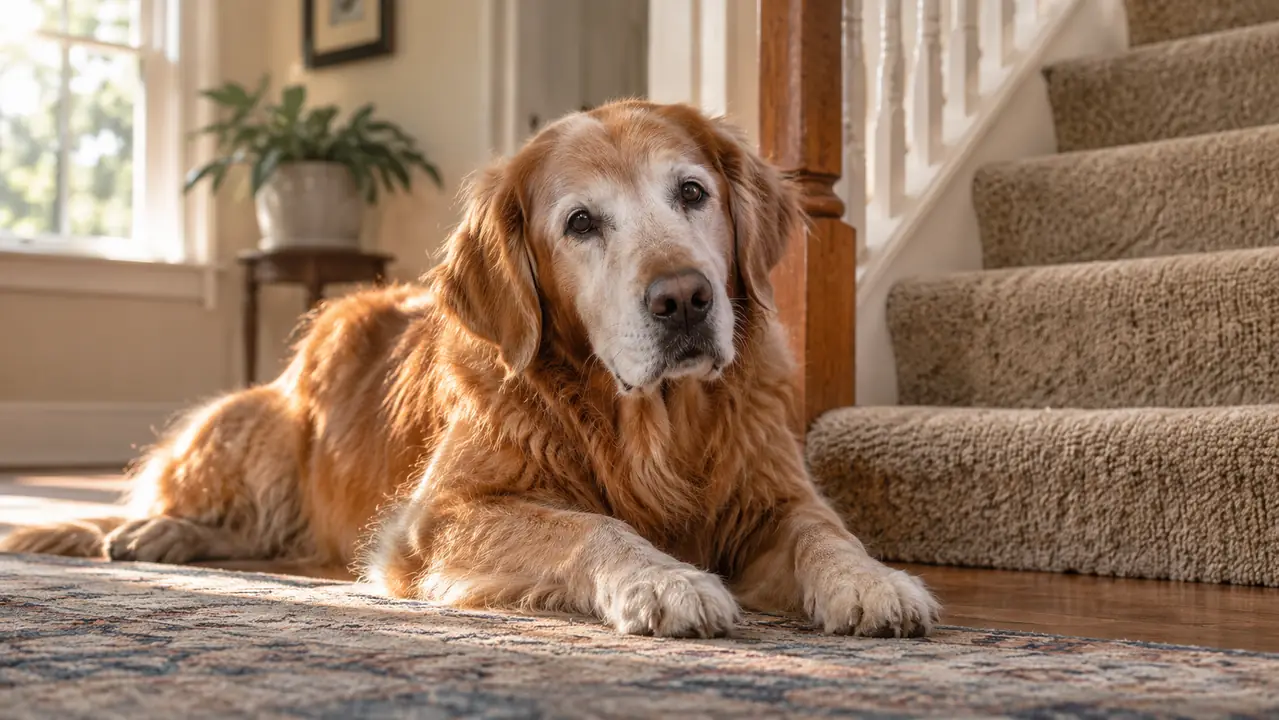
The staircase in our house has thirteen carpeted steps, and for ten years Biscuit went up and down them like the steps were not there. He is a twelve-year-old Golden Retriever, about seventy-two pounds, and roughly two years ago our vet pointed at an x-ray and said the word arthritis out loud. Last winter he started stopping on the fourth step. Not sitting down. Just stopping, back legs braced wide, waiting for something to change. Nothing changed, so I started putting my hands under his belly and lifting, which is a quick way to wreck a sixty-one-year-old's lower back and a lousy way to make a dog feel manhandled.
I tried the things people suggest. A ramp to the back deck, which he looked at once and refused. A bath towel folded under his hips, which works for about thirty seconds before it slides and bunches and pinches. Carrying him, which lasted one trip and ended with both of us unhappy. What finally worked was a rear support sling, specifically the LOOBANI adjustable sling, and the reason it worked is not that it is clever. It is that it lets me take maybe fifteen pounds of his weight off those back legs instead of all of it or none of it. What follows is what I actually learned over a year of using it, in the order I learned it, and the first thing I learned came from our vet rather than from me.
Take fifteen pounds off the back legs, not the whole dog
Adjustable rear support sling for large breeds, with a soft lining, a machine washable nylon body, and a storage bag that lives at the bottom of the stairs.
Amazon Check Today's Price on Amazon →Step 1: Get your vet's sign-off before you buy anything
I am not a vet and I am not going to write like one. Before we changed anything about Biscuit's routine, I asked our vet whether the stairs were still a good idea at all. Her answer surprised me. Keep him on them, in moderation, because a dog that stops climbing loses strength faster than a dog that keeps climbing with help. But she wanted to put her hands on his hips and his back first, and she wanted to watch him walk on flat ground before we asked him to do steps.
That conversation did two things. It ruled out damage we could not see, which was the thing keeping me up at night. And it gave me a baseline. On a good day he could do the whole flight with one pause at the landing. On a cold morning he needed a break at step four and again at step nine. Write your own baseline down on paper, because in three weeks you will not be able to tell the difference between a real improvement and a hope.
Ask about fit while you are there, and check your dog's weight against the listing before you order. The LOOBANI sling is adjustable, and the listing gives a weight range of fifteen to thirty kilograms, which is roughly thirty-three to sixty-six pounds, for large and extra large breeds. Biscuit sits near the top of that and the adjustment had room to spare. If your dog is well past it, that is worth a phone call rather than a guess.
Step 2: Put the sling on before your dog stands up
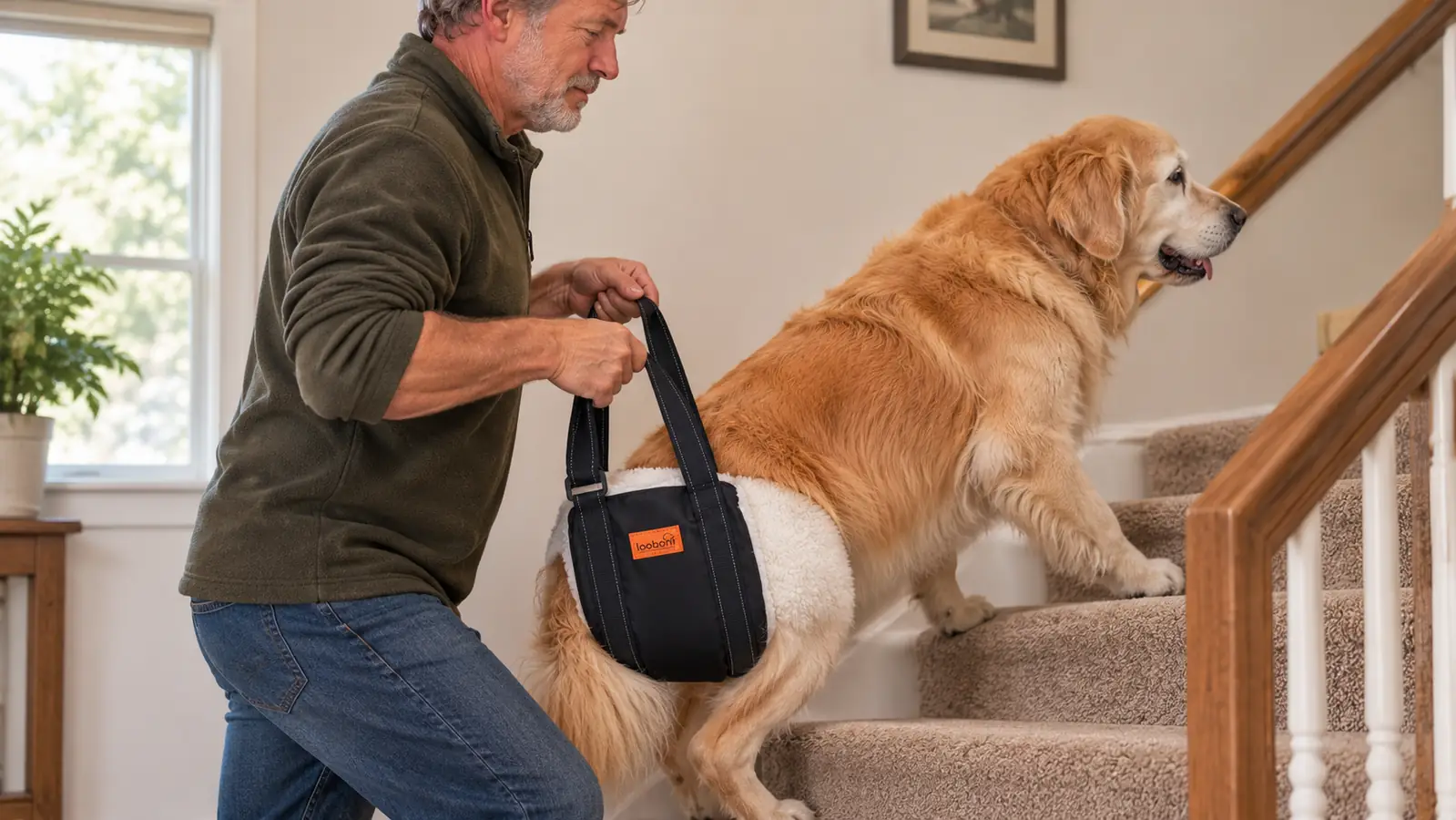
My first mistake was trying to slide the sling under a standing dog. He was already unsteady, I was crouched at a bad angle, and it turned into a shoving match on the kitchen floor. Do it while he is lying down and settled. Fold the sling, slide it under the hindquarters from the side, and smooth it flat so the fabric sits forward of the tail and behind the ribs, taking the belly rather than the spine.
The soft lining matters more than I expected. The first week I had it bunched and it left a red line across his flank after about twenty feet of hallway. Once I slowed down and got it flat, that stopped. The machine washable part is not a marketing line either. I washed it every week that first month and it came out of the machine the same shape it went in.
Keep the storage bag. Mine lives on the newel post at the bottom of the stairs. That sounds fussy until the evening your dog decides to head up without you, and the difference between a sling on the newel post and a sling in a kitchen drawer is the difference between helping and watching.
Step 3: Take part of the weight, not all of it
This is the part I got wrong for two weeks. I was lifting so much that his back feet barely touched the treads. He was not climbing, he was being carried with extra steps. Our vet caught it in about four seconds and said the thing I still hear in my head: if his feet are not feeling the step, his legs are not learning anything and they are not staying strong.
The right feel is closer to holding the seat of a bike while a kid learns to ride. You follow the motion, you take the wobble out, you let the legs do the work. Start with more support on the bad days and less on the good ones. On a cold morning I take more of him. By the evening trip, less.
Keep your own body in it too. I am sixty-one and my back is not a crane. Stand beside and slightly behind your dog rather than in front, keep your elbows in close, and let your legs do the lifting. If you have to twist to reach the sling, the sling is in the wrong place, not your arm.
One more thing about support: use two hands when you can. That sounds obvious and I still catch myself with a mug in one hand and the sling in the other. If both hands are not on the job, your dog is doing more of the work than you think he is.
Step 4: One stair at a time, and let him set the pace
Biscuit wants to go up fast, which is how he got into trouble in the first place. The rhythm that works for us is front paws up one step, pause, back legs come up together, pause. It is slower than you think it should be. It is also the difference between a clean climb and a scramble where one back foot misses the tread and everything lurches forward at once.
Going down is harder, and nobody warns you. Coming down, the back legs carry more of the load and the dog cannot see the tread under his own hips. I go down ahead of him at an angle with one hand on the sling and I do not let him hurry. On the three shallow wooden steps off the back deck, which get a little slick in the rain, I take nearly all of his weight and let him place each foot deliberately.
The car is the same job in a smaller space. He cannot hop into the back of our CR-V on his own anymore, so I open the tailgate, he puts his front paws up on the sill, and the sling takes his back end while he pushes off. Same order every time. The sameness is what makes it work.
If he refuses a step, do not pull. Stop, let him reset, try once more. If he refuses twice, that is your answer for the day and you turn around and go back down. In a year of this I can count on one hand the times he refused and turned out to be wrong about it.
The sling does not carry your dog. It carries fifteen pounds of him, which turns out to be the fifteen pounds standing between him and the stairs.
Step 5: Build a routine, then write down what changes
We do the stairs three times a day: morning, mid afternoon, bedtime. Same order, same sling, same landing spot at the top. Dogs are conservative about routine and Biscuit will attempt something he has done a hundred times far more readily than something new.
Once a week, add a line to the note you started in step one. How many pauses, which step he stopped on, whether the back feet came up together or one dragged. This is not busywork. It is the only way I have found to tell a bad week from a real decline, and it is the first thing our vet asks for at every appointment now.
Cold mornings are their own routine. On those nights I carry the sling up with me so I am not walking down and back up to fetch it while he stands at the bottom getting stiffer. Twenty seconds of planning saves him two minutes of standing.
Wash the sling weekly, and more often in mud season. A sling with grit worked into the lining is a sling that rubs, and a sling that rubs is one your dog will start dodging when he sees it come off the newel post.
What Else Helps
The sling is one piece of this. It does not fix the hips and it is not meant to. What it does is keep your dog moving while the other pieces do their work, and the other pieces matter.
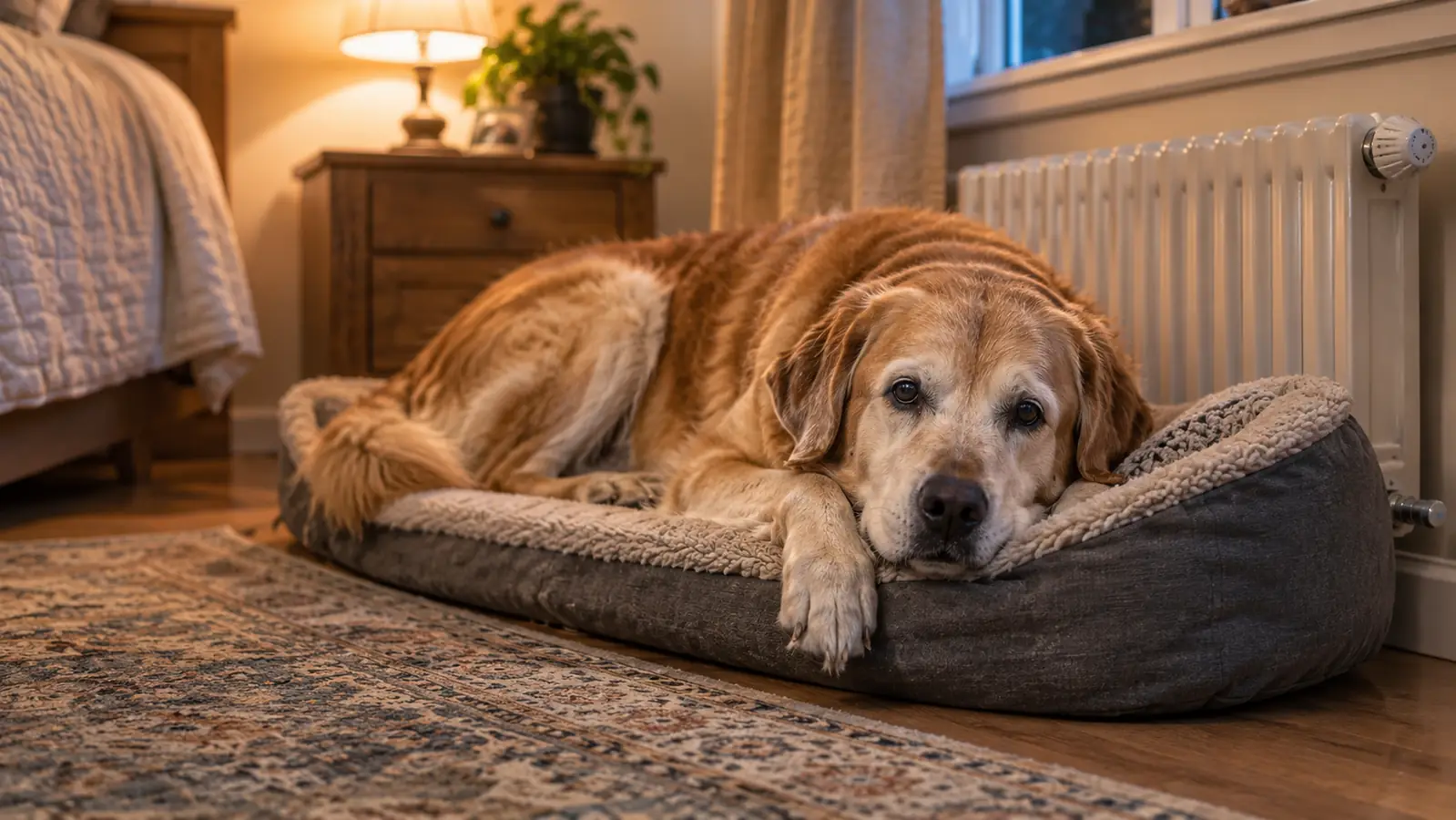
Surfaces first. We put a cheap low pile runner across the landing so Biscuit is not hitting bare wood at the top of the stairs, and his nails get trimmed more often than they used to. A long nail on a hard tread is a slip waiting to happen. His bed moved out of the cold corner of the bedroom to a spot near the radiator, because a stiff dog on a cold morning is a dog who will not attempt the stairs at all.
Weight is the least fun conversation and the one our vet was bluntest about. Five pounds off a dog with hip arthritis does more than most of what you can buy. Biscuit gets a measured scoop now instead of a topped off bowl. He is not thrilled about it. His back legs are better for it.
And keep the walks. The evening loop around the block is still the best part of his day and it is doing real work for his strength. It is slower than it used to be. It still happens. The LOOBANI sling has held its shape through a year of weekly washing, which is more than I can say for the towel.
What I Liked
- Takes a predictable share of the weight off the back legs, which is easier on the dog and on your back than a folded towel
- Adjustable fit with a soft lining, and the nylon body goes in the machine
- Folds into the included storage bag so it stays at the bottom of the stairs where you need it
- Simple enough that a neighbor or a dog sitter can use it correctly after one walkthrough
Where It Falls Short
- The listed weight range tops out around sixty-six pounds, so a dog well above that should be fitted carefully
- It does nothing for the front end, which matters if your dog also has shoulder or elbow trouble
- The lining holds grit between washes, and a gritty sling rubs
- It is not hands free. You are walking beside your dog, bending and pacing with him
The stairs are not going anywhere. The lift can get easier.
Adjustable rear support sling for large breeds, with a soft lining, a washable nylon body, and a storage bag for the newel post. Ask your vet first, then check your dog's weight against the listed range.
Amazon Check Today's Price on Amazon →