
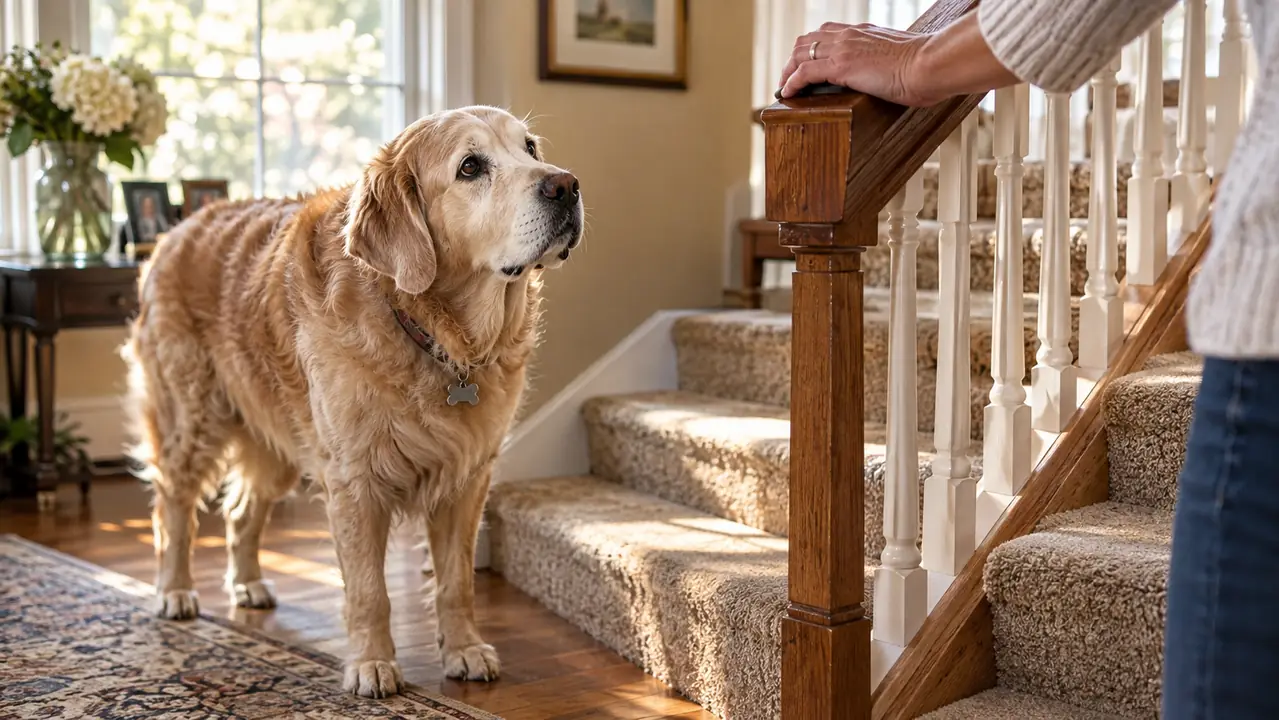
There is a sound my house makes now that it did not make two years ago. It is Biscuit's front nails on the sixth stair, a slow tick tick tick, and then a pause long enough that I stop rinsing a dish and listen. He is a 12-year-old Golden Retriever, about 72 pounds, and our vet diagnosed arthritis in both hips about two years ago. Cold mornings are the worst. So are the first three steps after a long nap, when his back legs seem to need a moment to remember what they are for.
For a while I did what most of us do, which is improvise. I looped a bath towel under his belly, and it worked for about four days before it slid forward and I nearly lost my grip on the fourth stair. I tried carrying him. That lasted one attempt and left my lower back sore for a week. Then I ordered the LOOBANI adjustable dog sling, largely because it was described as hind leg support for large dogs and because it folded small enough to keep by the stairs. I have now used it through a hard Ohio winter and a muddy spring, three or four times a day on the bad days, and I have opinions about it.
The Quick Verdict
A plain nylon sling with a soft lining that lets me take real weight off Biscuit's hind end on stairs and in the car. Not a cure, not comfortable for long walks, and my shoulder does the lifting. But it has kept him using his own stairs for months, and that is the whole point.
Amazon Check Today's Price →The thing I wish I had bought before the bath towel
A sling that folds into a drawer and comes out in ten seconds when your dog hesitates at the bottom step. No batteries, no assembly, nothing to learn.
Amazon Check Today's Price on Amazon →How I've Used It
The routine is not complicated. I stand slightly behind and to the side of Biscuit, slide the lined part of the sling under his hindquarters, gather the ends in one hand, and lift as he steps. The drawstring closure keeps the fabric gathered where I set it. I adjusted the length twice in the first week, found the setting where my forearm sits at a natural height, and have not touched it since. That took about ten minutes total, including the two failed attempts where I had it too long.
It gets used most on the staircase, which is carpeted and has thirteen steps. Biscuit manages the first five or six on his own. The sling comes in around the seventh, which is where his back legs start to lag and where I can feel him thinking about it. Then I take maybe a quarter of his weight, not all of it. He is still doing the work. That distinction matters to me more than I expected it to.
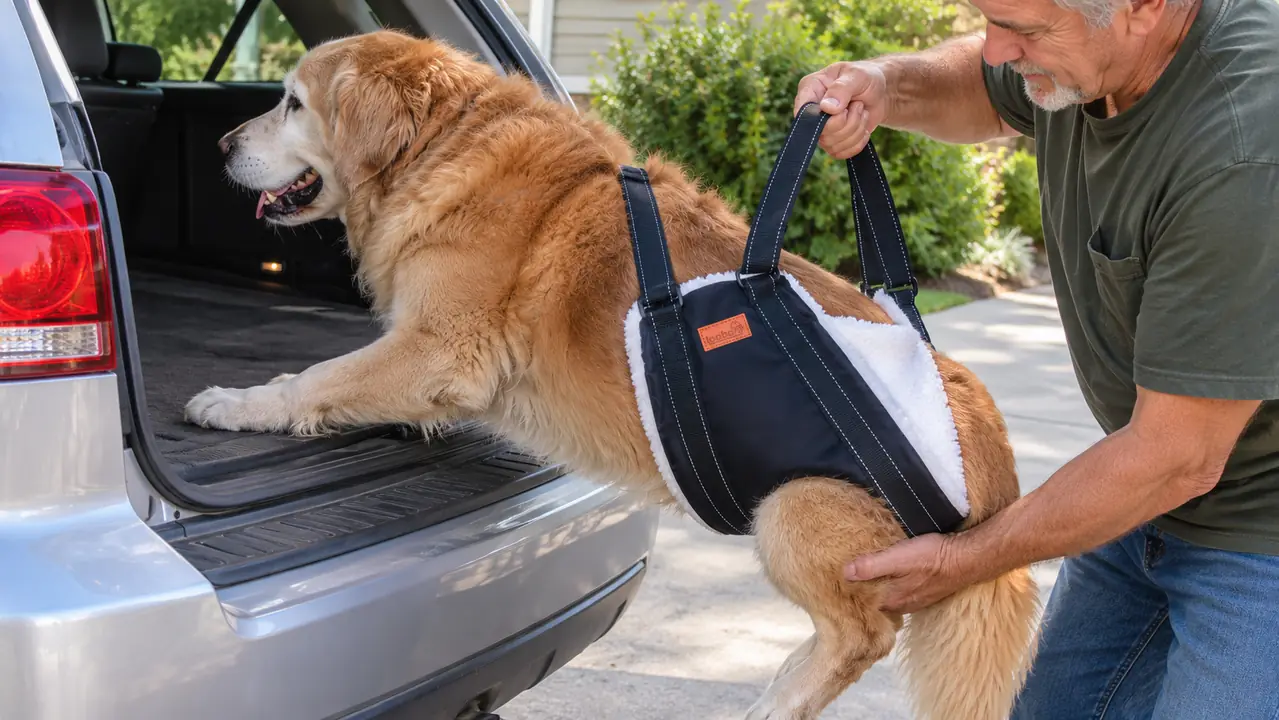
It also goes in the car, because Biscuit can no longer jump into the back of my CR-V on his own. He puts his front paws on the sill, I take his back end, and he brings his hind legs up. He learned the routine in about three attempts. The first time, he stood there and looked at me like I had lost my mind, then stepped up anyway.
I timed it once, out of curiosity, on a Tuesday morning in February when the thermometer on the back porch read nineteen degrees. From the moment I opened the drawer to the moment Biscuit's front paws hit the landing was fifty-one seconds. The sling itself was maybe eight of those seconds. The rest was him, deciding, sniffing the third step, taking the first one, and I have learned not to hurry that part. Hurrying him is how you get a dog who stops trusting the stairs altogether, and then no tool in the world helps you.
What It Is and What It Isn't
It is a piece of nylon roughly the size of a folded dish towel, with a thicker, sheepskin-like lining on the side that touches the dog and a drawstring closure. According to the listing it weighs a bit over seven ounces and folds into the small bag that comes with it. Nothing inflates. Nothing clicks. Nothing needs charging or replacing. Mine lives in the drawer of the side table by the front door, next to the leashes.
What it is not is a brace, a wheelchair, or a replacement for whatever your vet has told you to do. It does not hold Biscuit's hips in a particular position and it does not strengthen anything. It takes weight off, for the thirty seconds it takes to get up a flight of stairs or into the back of a car. That is the entire product. Some days that is exactly enough, and I have come to think of it the way I think of the handrail on my own stairs, which is to say I do not think about it until I need it.
The drawstring is the part I underrated. You loosen it, work the gathered fabric under the dog, then pull it snug so the lining stays put instead of sliding forward the way my towel did. That single detail is the difference between the bath towel and this. The towel had nothing holding it in place, so every lift pulled it out from under him and I was readjusting with one hand while he stood there wobbling on three legs. The LOOBANI sling stays where you set it until you decide to move it.
That small folded size matters more than it sounds. If the tool is not within arm's reach when your dog is standing at the bottom step looking up at you, you will not use it. You will try the towel again. I know this about myself, and I suspect it is true of most people reading this.
The Stairs, the Car, and Three Steps to the Yard
Two places in my house require it and one does not. The inside staircase requires it. The back deck, which has three shallow wooden steps down to the yard, generally does not, at least not going down. Coming back up is a different story, especially after rain when the wood is slick and he is tired from sniffing the same shrub he has sniffed for a decade. That is where the sling earns its keep on days I would not have predicted.
The car is the other place. Getting into the CR-V used to be a running start and a small leap. Now it is a two-person job that only needs one person, if that makes sense. Front paws up, sling under the hindquarters, lift and step. He is in and settled on his blanket in under a minute, and I am not worried about him landing badly on the driveway.
There was one morning in January I still think about. We had ice on the back steps, the kind you get when snow melts off the roof in the afternoon and refreezes overnight, and Biscuit went down fine and then could not get back up. Three shallow steps and he simply stopped at the bottom and looked at me. I put the sling under him and we took them one at a time, my hand under his hind end the whole way, and he came inside, drank half the water bowl, and slept for two hours. Without it I would have been carrying him up those steps or standing in the cold waiting for the sun to melt the ice.
What I did not expect was how much it would change his willingness to try. Before the sling, he would stand at the bottom of the stairs for a long beat, then turn and walk into the living room, and I knew he had decided the stairs were not worth it. He sleeps upstairs. So that decision meant he slept downstairs alone, which he hates. Now he waits at the bottom for me instead of turning away.
What Several Months of Daily Use Has Shown
The sling itself has held up without drama. The nylon has not frayed anywhere I can find, and the stitching at the ends where I grip it has not pulled. The sheepskin-like lining has flattened a little in the middle, where the pressure goes, but it has not worn through and it has not rubbed Biscuit's belly or the inside of his back legs, which was my main worry with a 72-pound dog. I run it through the machine every couple of weeks and let it air dry over the laundry sink.
I have washed it eleven times since March, which I know because I keep a note in my phone about his bad days and I started adding the washings so I could see whether the lining was holding up. It is. The fabric has softened and the sheepskin-like nap is thinner in the middle, but there is no pilling and no seam has opened. I drape it over the laundry sink and it is dry by the next morning. One small thing: the storage bag that comes with it is thin, and I stopped using it after a month. The drawer does the same job and I am less likely to leave it in the car.
The honest part is that Biscuit's arthritis has not improved. Nothing about a sling changes a hip joint. What changed is what he is willing to attempt. On his good mornings he walks past me and does the stairs himself, and I let him, because I do not want the sling to become a habit he leans on. On the bad mornings, the cold ones, he stands at the foot of the stairs and looks back at me over his shoulder, and I get it out of the drawer.
That back-and-forth is the real texture of using this thing for months. It is not a steady improvement story. It is a tool you pick up on the bad days and leave in the drawer on the good ones, and the fact that there are still good ones is worth noting.
Where It Falls Short
You are the lifting mechanism. There is no frame, no wheels, no lever, nothing that gives you mechanical advantage. My right shoulder does the work, and on a day when we do the stairs four times, I feel it that evening. If you have a shoulder or back problem of your own, this is not a small consideration. A sling distributes the dog's weight to your arm, not away from it entirely.
It is also not a walking tool, despite what you might imagine. I tried it on our evening walk around the block and gave up after a block and a half. Holding your arm at that angle while walking is awkward and tiring, and Biscuit found the whole thing confusing. This is a stairs, car, and furniture product. Nothing more.
Sizing deserves a word. The listing for the LOOBANI sling gives a weight range of 15 to 30 kilograms, which is roughly 33 to 66 pounds. Biscuit is about 72, so he sits a few pounds over the top of that range. It has held him without complaint for months, but I want to be straight about it rather than pretend he is a perfect fit. If your dog is well past that range, the fabric and the stitching are doing more work than the manufacturer intended.
There was also no real fitting guidance in the package, just the sling and the storage bag. I worked out the right length by trial, and those first two attempts were too long, which meant I was holding the ends too low and getting no leverage at all. Before I bought it, I looked at the full rear-support harnesses with straps that go around the back legs, and at a friend's suggestion of a beach towel with stitched handles. The harnesses give you more control and free up your other hand but take longer to put on. The towel is free and slides. I chose the middle option deliberately.
What I Liked
- Takes a real share of the dog's hind-end weight with one hand and one motion
- Soft sheepskin-like lining has not rubbed a 72-pound dog's belly or legs
- Light enough to fold into its own bag and keep in a drawer by the door
- Nylon and machine washable, which matters more than I expected in a wet climate
- Adjusts once to your height and then you stop thinking about it
Where It Falls Short
- Your shoulder absorbs the load, so it is a poor fit if you have arm or back trouble
- Not usable for walks, only stairs, vehicles, and furniture
- Biscuit sits a few pounds over the top of the listed weight range
- No fitting instructions in the package, so plan on two or three trial adjustments
- The lining flattens in the middle after a few months of steady use
The sling does not make Biscuit younger. It keeps the sixth stair something he still does on his own, and that turns out to be the part I care about.
Who This Is For
This is for the person standing behind a large older dog at the bottom of a staircase, waiting, watching the back legs decide. It suits a dog who can still walk, still get around the house, still do his evening loop of the block, but who has two or three specific places in his day where his hind end gives out. Stairs, the car, the couch, the vet's slick exam room floor. If you can name those places, you already know whether a sling would help.
It also suits a household with one reasonably strong adult in it. Biscuit is 72 pounds and I am 61 with a hip that is not what it was. I can manage him alone with this. I would not want to manage a 100-pound dog alone with anything short of a proper harness, and I would say so to your face. The LOOBANI sling is built around large breeds, and at his weight Biscuit is already close to the top of what the listing calls for.
Who Should Skip It
Skip it if your dog has lost the ability to bear weight on his hind legs at all, because a sling assumes he is still doing most of the work and it will not carry him. Skip it if your vet has recommended a specific brace or a mobility cart, since this is neither and will not do their job. Skip it if you have shoulder or lower back trouble and no one else in the house to do the lifting, because the load has to go somewhere. And skip it if your dog panics at things passing under his belly, which some rescues do. Biscuit accepted it in two days. Not every dog will, and no sling in the world is worth a fight on the stairs. Whatever your situation, run it past your vet before you change a routine around a 12-year-old dog, the same way I did.
If your dog still takes the stairs, just not alone
Folds into a drawer, comes out in ten seconds, and gives you a hand under the hind end for the parts of the day that got hard.
Amazon Check Today's Price on Amazon →