
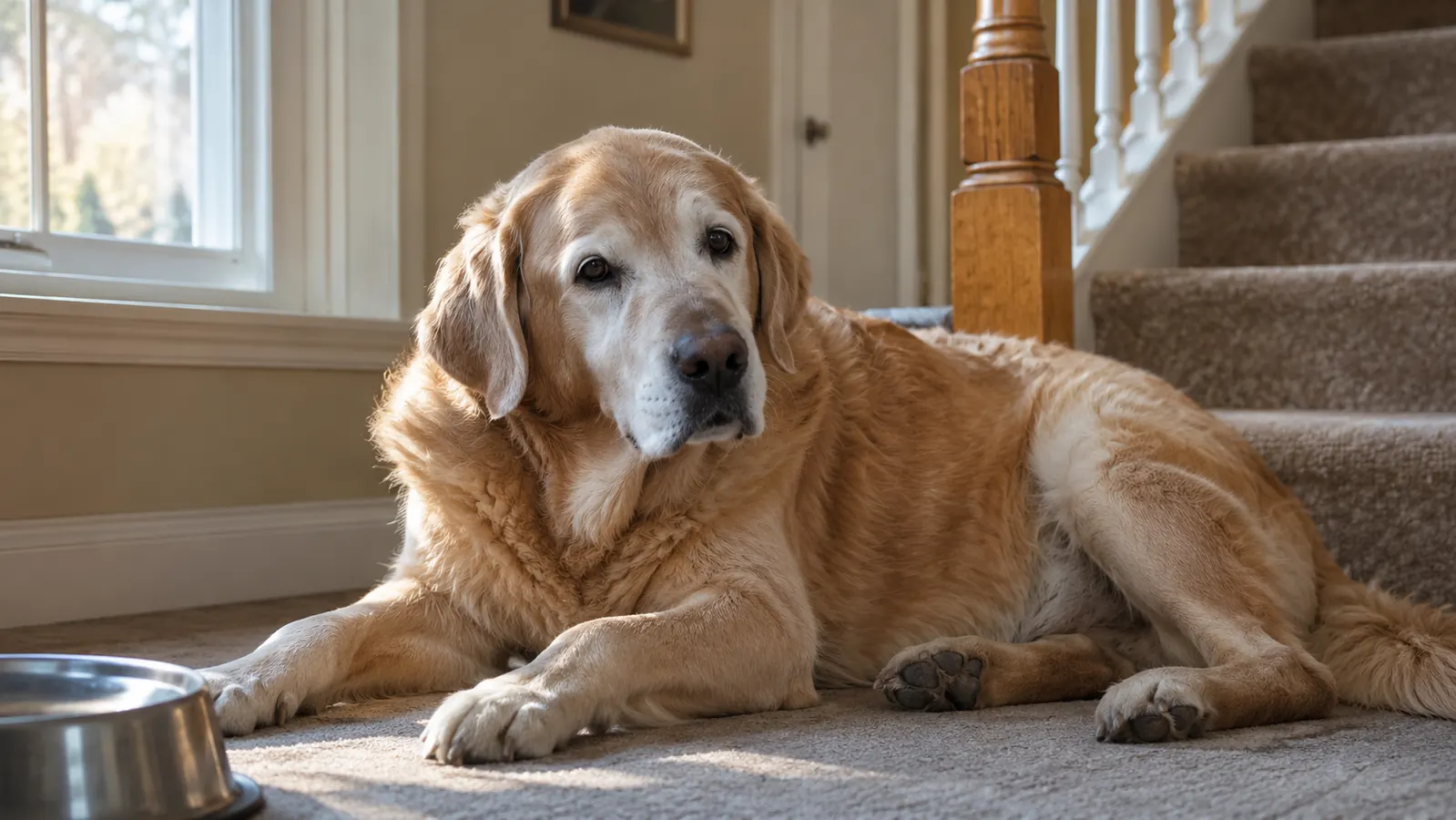
The first cold morning in November is how I found out how bad it had gotten. Biscuit, my twelve year old Golden Retriever, got to the top of the carpeted staircase, looked down, and stopped. Seventy two pounds of dog, all four feet planted, waiting for me to go first. He used to take those stairs at a trot. Now he takes them one at a time and rests on the landing.
That was two winters ago. Our vet had already diagnosed arthritis in both hips, and I had already tried the things most of us try first. I changed his food. I bought a thicker bed. I bought a harness with a handle so I could help him down the three wooden steps to the back deck. None of it was wrong, exactly. It just was not the whole job. The piece I had been missing was the boring one: a chewable joint supplement from Nutramax Laboratories called Cosequin, given consistently for long enough to matter, plus a handful of small changes around the house that made his days easier. This is that routine, step by step, in case your dog is standing at the top of the stairs doing the same arithmetic I was.
The bottle our vet's office already knew by name
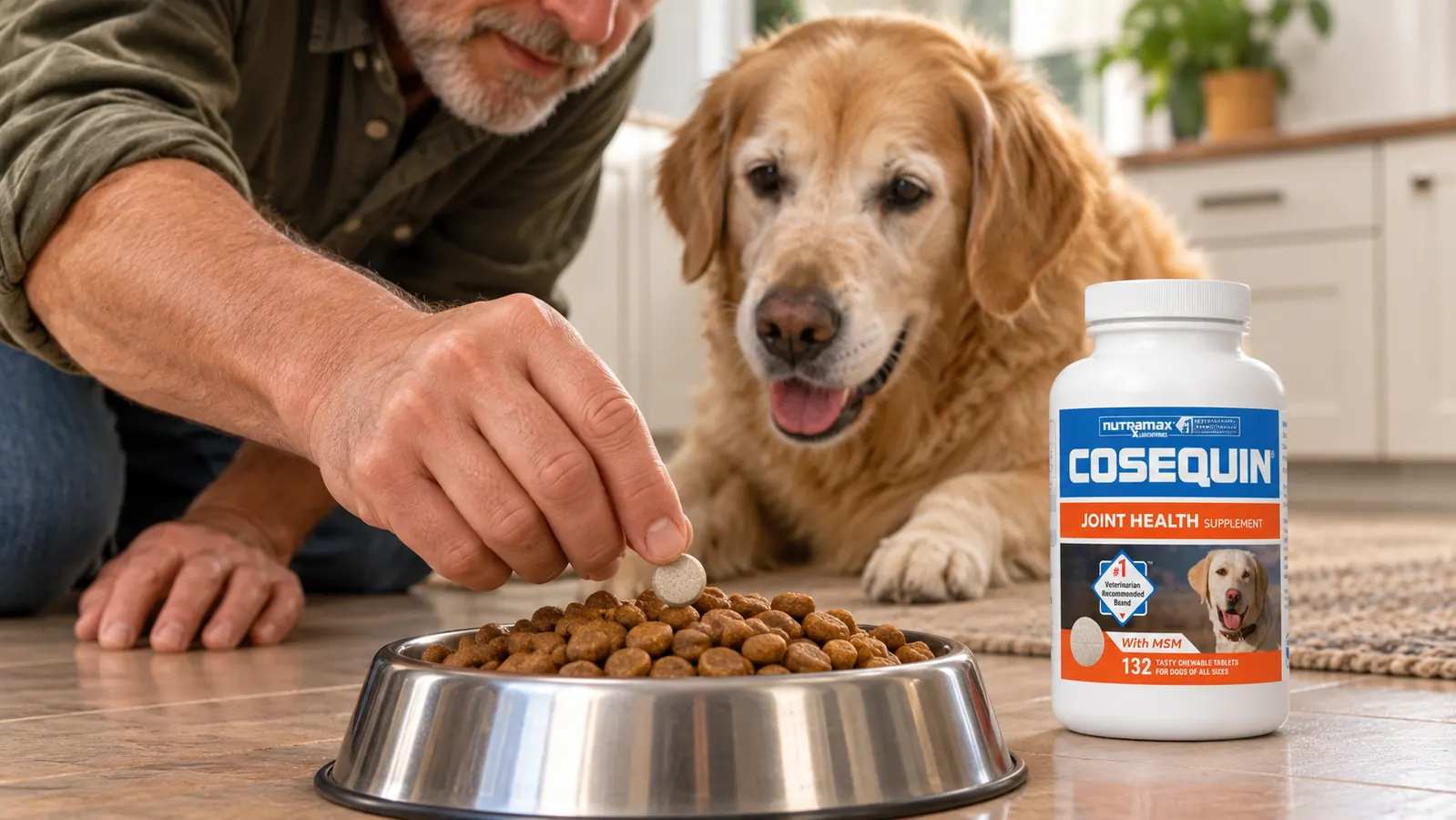
Cosequin chewable tablets for dogs, 132 in the bottle, from Nutramax Laboratories. Glucosamine hydrochloride, sodium chondroitin sulfate and MSM in a tablet most dogs take like a treat. Ask your vet first, then give it eight weeks before you judge it.
Amazon Check Today's Price on Amazon →The Five Steps, in the Order I Would Do Them Again
Step 1: Get your vet's sign-off before you buy anything
I know. Everyone says this and it reads like a disclaimer at the bottom of a page. It is not. When I described the stiffness, our vet put his hands on Biscuit's hips and back legs and moved them through their range. He found things I had not noticed, like the way Biscuit had started swinging his left back leg out to the side instead of bending it. That kind of finding changes what you buy. If your dog is guarding a leg because of a torn ligament, a supplement is not the answer. If the stiffness is arthritis, as it was here, you are in the right aisle.
The second reason to call first is medication. Biscuit was already on a prescription anti-inflammatory for his bad days, and I wanted to know whether a supplement would sit fine alongside it. That took one phone call. Our vet's office asked what I was considering, said the ingredients were reasonable, told me to follow the label rather than improvise, and asked me to call back if I saw any stomach upset in the first couple of weeks. Then they told me to give it at least a month before I formed an opinion.
Write down what you actually see before you start. Not he seems stiff. The specific thing. He takes the stairs one at a time. He needs a nudge to get up off the living room rug. He walks to the corner and turns around early. You will want that note in eight weeks, because improvement in an older dog is slow and quiet, and memory is generous in both directions.
Step 2: Start Cosequin at the label serving and then leave it alone
Cosequin comes as a chewable tablet, and the label gives a serving size based on your dog's weight. I follow it exactly as written. I did not double it in the first week hoping for a faster start, and I do not skip days when he seems fine. Consistency is the whole mechanism. A joint supplement is not a pain pill that works in forty minutes. It is closer to a daily deposit, and the account builds slowly.
The formula is glucosamine hydrochloride, listed as FCHG49, sodium chondroitin sulfate, listed as TRH122, and MSM. Those three are why I picked this over the store brand tub with a picture of a happy dog on the front. Nutramax Laboratories has been in pet health for more than 25 years, and the product listing describes Cosequin as the number one vet recommended retail joint health supplement brand. I cannot verify that number myself. What I can tell you is that when I said the name at our vet's front desk, nobody had to look it up.
Biscuit is not a fussy dog and takes the tablet as if it were a treat. If yours is pickier, the tablet crumbles well over a spoonful of wet food. Pick a time and keep it. Ours is after the evening walk, because that is the one moment of the day when I am always standing in the same place with the same bowl in front of me.
Step 3: Fix the floors before you fix the dog
This one cost almost nothing and did more visible good than anything else on the list. Our downstairs hall is hardwood and the stairs are carpeted, and Biscuit had started doing a small scrambling thing with his back feet whenever he turned around on the wood. Watching closely, I realized he was not only stiff. He was worried about slipping, and a dog who is worried about slipping stops moving, and a dog who stops moving gets stiffer.
I put a cheap runner down the hallway and a second one at the foot of the stairs. I put a folded blanket on the landing where he likes to rest. I trim his nails on a schedule now instead of when I happen to think of it, because long nails change how a dog's foot sits and none of this gets easier with age. On the deck, the three wooden steps are shallow and he manages them, but I go down first and stay at the bottom while he takes his time.
None of that is training. It is removing the parts of the day that make him brace. If your dog slides on tile in the kitchen, mats in front of the sink and the fridge sound fussy and are not. Biscuit cannot get into the back of our CR-V on his own any more, so there is a folding step by the rear door. It is the difference between a dog who still goes places and a dog who stays home.
Step 4: Shorten the walks and add one
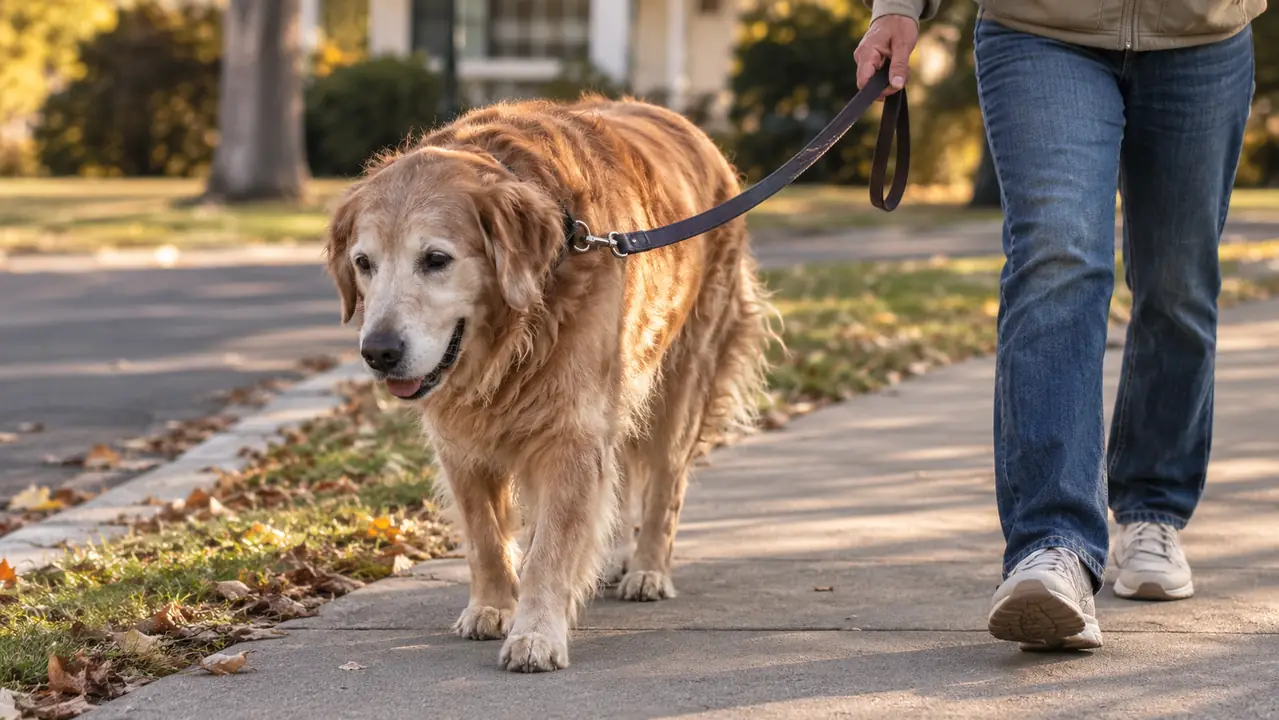
The instinct, when a dog slows down, is to cut the walks. I did that at first and it backfired. Biscuit lost condition, got stiffer, and got bored, which for a retriever is a real problem and shows up as pacing and a lot of sighing. What worked better was keeping the number of walks and shortening each one. We still do the same block in the evening that he has always loved, just slower and with more stops to sniff. The morning walk became a short loop in the yard instead of a second full block.
Five slow minutes before any real walking helps more than it sounds like it would. I let him out, he wanders the yard sniffing at everything, and by the time we head down the driveway his back legs have loosened up. Cold mornings are still the worst ones. On those, we skip the driveway and do the yard loop twice, and he does not seem to hold it against me.
Then there are the days he tells me. If he stops halfway down the block and stands, we turn around. That is not a failure of the routine. It is the routine working, because the point was never to cover distance. It was to keep him moving enough that the movement stays easy.
Step 5: Keep a log you can actually defend
There is a paper calendar on the inside of the pantry door. Every day gets one mark. A dot for a normal day, an X for a bad one, nothing else. After a few months I could see things I would never have trusted from memory. His bad days clustered in the two days after a long car ride. The stretch from March into May was better than any stretch before it. Neither of those would have survived my recollection, and both changed how we plan a week.
Judge in three week blocks, not in days. An older dog has good weeks and bad weeks for reasons that have nothing to do with you, including weather, sleep, and whether the mail carrier came early. If you change three things at once and he improves, you will not know which one did it. That is why I did this a step at a time, and why the calendar on the pantry door carries more weight than my opinion of it.
Give the whole thing eight to twelve weeks before you decide. If you are at week three and nothing has changed, you are not doing it wrong. You are at week three.
What Else Helps
Two smaller things, both free. The first is weight. Every extra pound on a dog with arthritis in both hips is a pound his joints carry up the stairs. Biscuit was about four pounds heavy two winters ago and our vet was blunt about it. We cut the between meal extras, which in this house meant the crusts, and he came back down to a healthy seventy two. The second is warmth. He has an old bed in the corner of the living room where a heating vent happens to run, and he has claimed it. A warm dog sleeps better and gets up easier in the morning.
The third is patience with yourself. I spent a month angry that I had not started sooner. It changed nothing for him and made me worse company. The stiffness had been there for a while before I saw it clearly, the way a slow change always is.
If you want to read more about the ingredients themselves, the difference between the glucosamine forms is worth half an hour, and it is the question I get asked most by friends with older dogs. The short version: the form matters less than whether you actually keep giving it.
Twelve weeks in, he went down the three wooden steps to the deck without stopping to think about it. That was the entire scorecard, and I will take it.
What This Will Not Do
Cosequin will not turn a twelve year old dog into a two year old dog, and anyone who tells you otherwise is selling something else. Biscuit still has bad mornings. He still hesitates at the top of the staircase when the cold gets into the house. The difference is that bad mornings are now the exception rather than the pattern, and on a good evening he still leans slightly toward the corner on our block walk, which is the whole reason we do any of this.
It is also not a substitute for a diagnosis. If your dog is suddenly lame, yelping when picked up, or unwilling to put weight on a leg, that is a vet visit today, not a supplement and a wait.
What I Would Tell a Friend Who Asked
If you stopped me in the driveway and asked what to do first, I would say call the vet and describe the specific thing you are seeing. Then buy one bottle of Cosequin, follow the label, put a runner on the hallway floor, and write the start date on the calendar on the pantry door. That is the whole plan. It is not dramatic and nothing about it photographs well, but it is what gave me back a dog who takes himself down the stairs again.
And I would tell you to expect it to be slow. Somewhere around week ten I had stopped looking for a change, which is exactly when I noticed one. He was at the top of the stairs, and he went down without waiting for me.
Start with the bottle that comes 132 tablets deep and has a name the front desk recognizes
Cosequin chewable tablets for dogs, from Nutramax Laboratories. Follow the serving on the label for your dog's weight, ask your vet first, and give it eight to twelve weeks before you decide anything.
Amazon Check Today's Price on Amazon →