
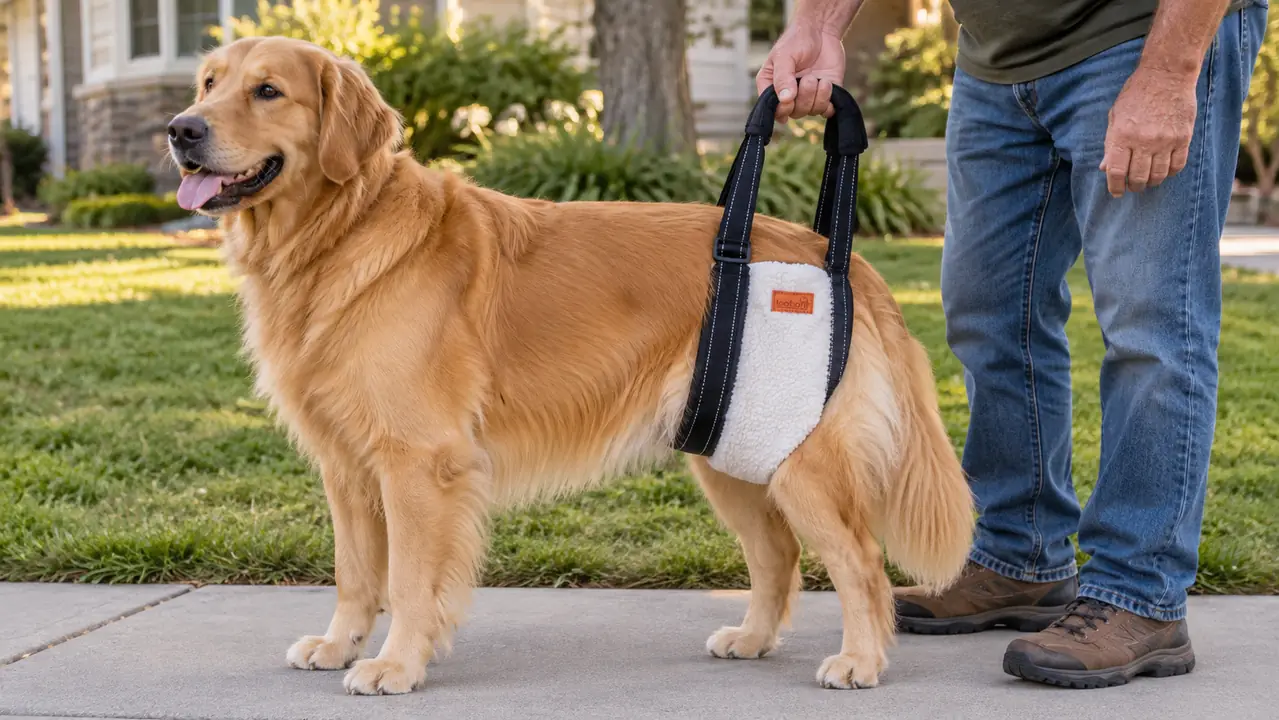
The first time I put the LOOBANI dog sling on Biscuit, I did it wrong. I gathered the strap in one fist and hauled upward like I was lifting a suitcase, and he lurched sideways into the doorframe. Seventy-two pounds of Golden Retriever stood there looking at me like I had lost my mind. My lower back ached for two days afterward, and I remember thinking that if this was the help, I was not sure I wanted it.
That was four months ago. Our vet had already told us, at Biscuit's checkup, that the arthritis in both hips was not going to reverse, and that the job now was keeping him strong enough to keep moving. I bought the LOOBANI sling hoping it would buy us another year of his short evening walk around the block. It has, mostly. But it took me about three weeks and a few mistakes to use it properly, and there are two situations where I still do not reach for it at all.
So this is the honest version, not the version I would have written in week one. What the sling does well, where it genuinely falls short, the sizing detail that nearly made me box it back up, and the small change in habit that turned it from a frustrating purchase into something I keep by the back door.
The Quick Verdict
A useful mobility aid for a large dog whose hind legs are weakening, once you shorten the strap and accept that it is a short-distance handling tool, not a fix for the arthritis itself.
Amazon Check Today's Price →The strap that ended the long pause at the top of the steps
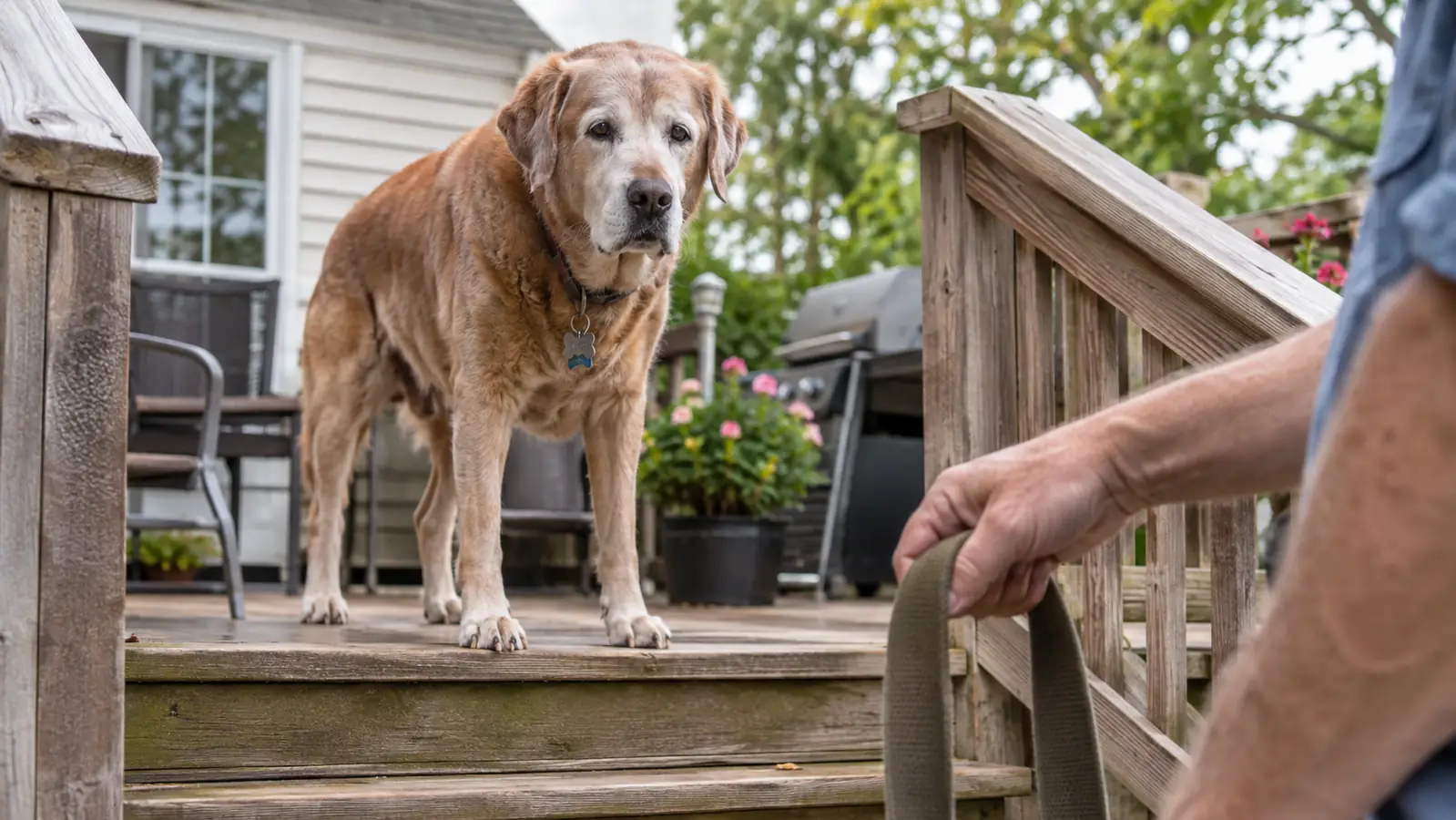
Biscuit used to stand at the top of the deck steps and think about it. Two weeks with this sling and the pause was gone. It is not treatment, but it is a way to keep saying yes to the walk.
Amazon Check Today's Price on Amazon →How I've Used It
The routine is the same every evening now. I fold the sling, tuck it under Biscuit's hindquarters while he is standing, and settle the lined section flat against him so nothing is bunched or twisted. My left hand takes the strap. My right hand holds his collar or a loop of the leash for steering. He sets the pace, which is slow, and I have stopped trying to hurry him.
The first two weeks, I only used it for the walk itself. Then I started using it for the three wooden steps down to the back deck, and that is where I noticed the real difference. Before the sling, he would stand at the top of those steps and consider them for a long moment. Now he goes down without the pause. That pause was the thing that worried me most. It looked like a dog weighing up whether the trip was worth the risk.
Before the sling I tried a full-body harness with a handle sewn across the back. It sounds like the obvious answer, and for a smaller dog it probably is. On Biscuit the handle sat at exactly the height that made me bend at the waist, and by the end of the block my lower back was complaining louder than he was. The handle also pulled the whole harness sideways when I lifted, so the padding that was supposed to sit on his chest ended up tucked under one armpit. I used it four evenings and then hung it in the garage, and I am not proud of how relieved I was to stop.
The other habit I had to break was helping too early. In January I was reaching for the sling the moment he slowed, and I think I made him anxious about the whole business. Now I wait until he actually stops and looks at the steps. He tells me when he wants the help. It sounds like a small thing. It changed the mood of the evening completely, and it changed my own back as well, because I stopped doing a small lift twelve times a walk and started doing one real lift twice.
I also use it to get him into the back of my silver Honda CR-V. He cannot jump in on his own anymore. With the sling on, he puts his front paws on the bumper and I take the back half of him up and in. I would not call it graceful. I would call it reliable, and reliable is what I wanted.
The Sizing Detail That Nearly Sent It Back
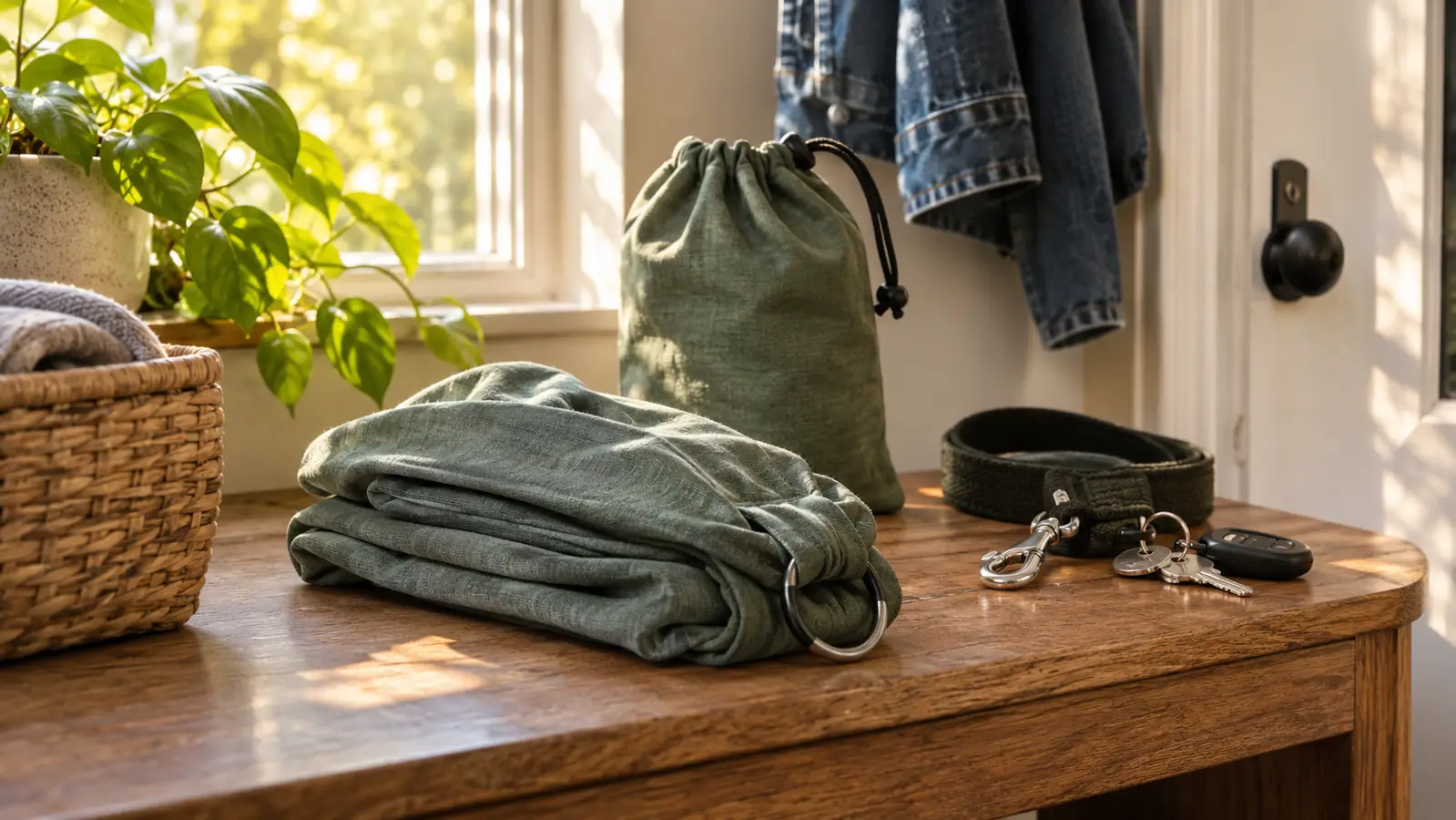
The box that arrives is small, maybe eight inches long, and inside is the sling and a drawstring storage bag. The whole thing weighs about seven ounces, which surprised me given the job I was handing it. It is nylon with a thickened, sheepskin-like lining where it meets the dog, and the straps adjust for length. Folded, it fits in the bag and lives on the shelf by the back door.
Here is the part nobody tells you. This is the Large size, and the weight range listed is 15 to 30 kilograms. That works out to roughly 33 to 66 pounds. Biscuit is 72 pounds. He is over the stated range by about six, and he is not an enormous Golden, just an old one who has kept his weight. I nearly sent it back on that number alone.
I am glad I did not, because four months of daily use has not produced a single popped stitch, and the lining has not flattened or torn. But I want to be straight with you. If your dog is 90 pounds or more, or if he is a strong dog who still pulls, be honest about that before you order. The material is nylon, and nylon carrying a moving dog takes the load on a fairly narrow band. I would want to hear from owners of genuinely giant dogs before I trusted it at that end of the scale.
The other adjustment is the strap. It is adjustable, and the right setting is far shorter than I first assumed. Short enough that you are standing upright with your hand near your hip. If you have to lean forward to reach the strap, you will spend the whole walk lifting with your lower back, and that is exactly how week one went for me.
Where It Genuinely Helps
The LOOBANI sling earns its place on the deck steps, as I said. The car. Getting him off the slippery kitchen floor after he has been lying there while I cook. And the walk itself, on the evenings when he is stiff from a cold morning. On those evenings he still wants to go, and I can now say yes instead of making him stay home. For a 12-year-old dog, being told no to the walk is its own kind of loss.
The kitchen floor is tile and it is slick, especially when the refrigerator has been open and someone has tracked across it. In February he went down on it trying to turn around at his water bowl, back legs sliding out, and he could not get them back under himself. That is the worst feeling, watching a big dog scrabble. I got the sling under him, took the strap, and he planted his front feet and pushed up. It took maybe fifteen seconds. Before the sling I would have been pulling on his collar, which does nothing for the back end, or lifting him by the hips, which is what set my back off in week one.
Now there is a cheap rubber mat by the water bowl and the sling still lives on the counter. I do not use it every day. Some weeks it comes off the shelf twice. That is the honest ratio. It is not a daily-use item for us, it is a tool for four or five specific moments a week, and I have made my peace with that. Expecting it to be more than that is how people end up writing a frustrated review of a product that is doing exactly what it was built to do.
The other thing it does, and I did not expect to care about this, is that it stopped me from grabbing him by the hips. I had been doing that, one hand on each side of his back end, hoisting. He never yelped, but he would go still and stiffen, and I think now that it hurt. With the sling, my hands are on a strap and his weight is spread across padding instead of my fingers.
What the sling actually gave us was a way to keep moving while the vet's slower plan did its work. It is a handling aid. It is not treatment, and it will not fix a hip.
Where It Does Not Help
The carpeted staircase inside our house. Thirteen steps up to the bedrooms, and I cannot hold a strap, hold the handrail, and manage 72 pounds of dog at the same time. I tried it twice and stopped, because the second attempt frightened me.
Here is what happened the second time. I clipped the leash to his collar, put the sling under him, and started up with my right hand on the sling and my left hand reaching for the rail. The rail is on the left going up, so my arm crossed my body at an awkward angle. Somewhere around the fourth step he stopped to rest and sat down on the stair, the sling went slack, and for a second I had a big dog parked on a step above me with nothing holding him but a nylon band and one wrist. He was fine. I was not. I sat down on the stairs next to him for a minute, then we went back down and I have not tried again since.
If your house is laid out like ours, the answer is probably a gate at the bottom of the stairs so he simply does not go up, or a conversation with your vet about what to do instead. I am not going to tell you a sling solves a staircase. It did not solve mine, and I would rather say so than have you find out on the fourth step with a dog sitting on you.
Getting up from lying down. The sling is designed to support a dog who is already standing or nearly there. It does not slide under a dog who is flat out on the rug and lift him. You still have to help his front end up first. If he cannot do that much on his own, this is not the tool you need.
And it does nothing for the arthritis itself. I want to be plain about that, because the listing language can make it sound like more than it is. It takes some strain off the hindquarters while the dog moves. The joints are exactly as they were. It buys you movement, not repair.
The Part About Your Own Body
Nobody mentioned this in the reviews I read before buying. A sling only works if the person holding it is positioned well. My first week, I was crouching and reaching, and my back ached every evening. Once I shortened the strap and started standing tall with the dog's weight close to me, the ache stopped entirely.
I am 61. I am not going to out-lift a dog and I should not try. If you have back trouble, shoulder trouble, or balance trouble of your own, ask your vet or a physical therapist to watch you do it once before you make it a daily habit. There is a right way that uses your legs, and it is worth ten minutes of instruction rather than three weeks of figuring it out alone in a driveway.
Four Months Later
The sling goes in the washing machine, which matters more than you would expect for something that sits under a dog's belly. I wash it every couple of weeks with the dog towels, cold, and let it air dry over the deck rail. The first time I ran it through the dryer by accident and the lining came out slightly crimped along one edge. It flattened back out after a day under him, but I would not make a habit of the dryer.
The lining has not pilled. The stitching at the strap attachment points, which is where I expected a failure, looks exactly as it did in March. I check those two points once a month now, the way I check the car straps before a long trip, because that is where a problem would start.
Biscuit tolerates it. He does not love it. When I pick it up he gives me a long look, then stands still while I position it, and for a dog that is a fairly strong endorsement. He has never tried to mouth it or wriggle out from under it, and he wriggles out of nearly everything.
And I still think a 72-pound dog is at the top of what this should carry. If Biscuit were 85 pounds I would be looking at a different product entirely. That is my honest read after a winter and most of a spring with the LOOBANI sling, and it is the thing I would most want a stranger to know before they order one.
What I Liked
- Light enough to fold into the drawstring bag and keep by the door
- The sheepskin-like lining has not rubbed or flattened after four months
- Adjustable strap lets you stand upright instead of bending over the dog
- Machine washable, which matters for something worn under the belly
- Turned the three deck steps and the car into non-events
- You can support the hindquarters without gripping the dog by the hips
Where It Falls Short
- The stated weight range stops at 30 kg, about 66 pounds, so a 72-pound dog is already over it
- No help at all for getting a dog up off the floor
- Not a solution for a full flight of stairs inside the house
- Takes two hands and practice to position correctly
- Does nothing for the arthritis itself
- Biscuit tolerates it rather than liking it
Who This Is For
Owners of a large dog whose hind legs are getting unreliable, but who can still walk, still get his front end up, and still wants to go. That is Biscuit exactly. If your dog matches that description, the LOOBANI sling will likely do what it did for us: take the hesitation out of the steps, make the car a non-event, and let you help him without hurting him or yourself. It also suits anyone who is strong enough to hold a strap but not strong enough to carry a dog, which is most of us past sixty.
Who Should Skip It
If your dog is well past 30 kilograms, or cannot get up at all without help, this is not the right tool and I would not pretend otherwise. If the staircase inside your house is the main problem, talk to your vet before you buy anything. And if your dog is recovering from surgery with a specific protocol, follow the protocol rather than an Amazon listing.
If you want something that treats the arthritis, this is not that either. It is a strap with a soft lining that lets you be a better pair of hands. That is all it is. Most evenings, that is enough for us.
If he still wants the walk, this is how you keep saying yes
It weighs seven ounces and folds into the little bag it comes with. It will not fix his hips. It will get him down the steps and into the car without either of you getting hurt.
Amazon Check Today's Price on Amazon →