
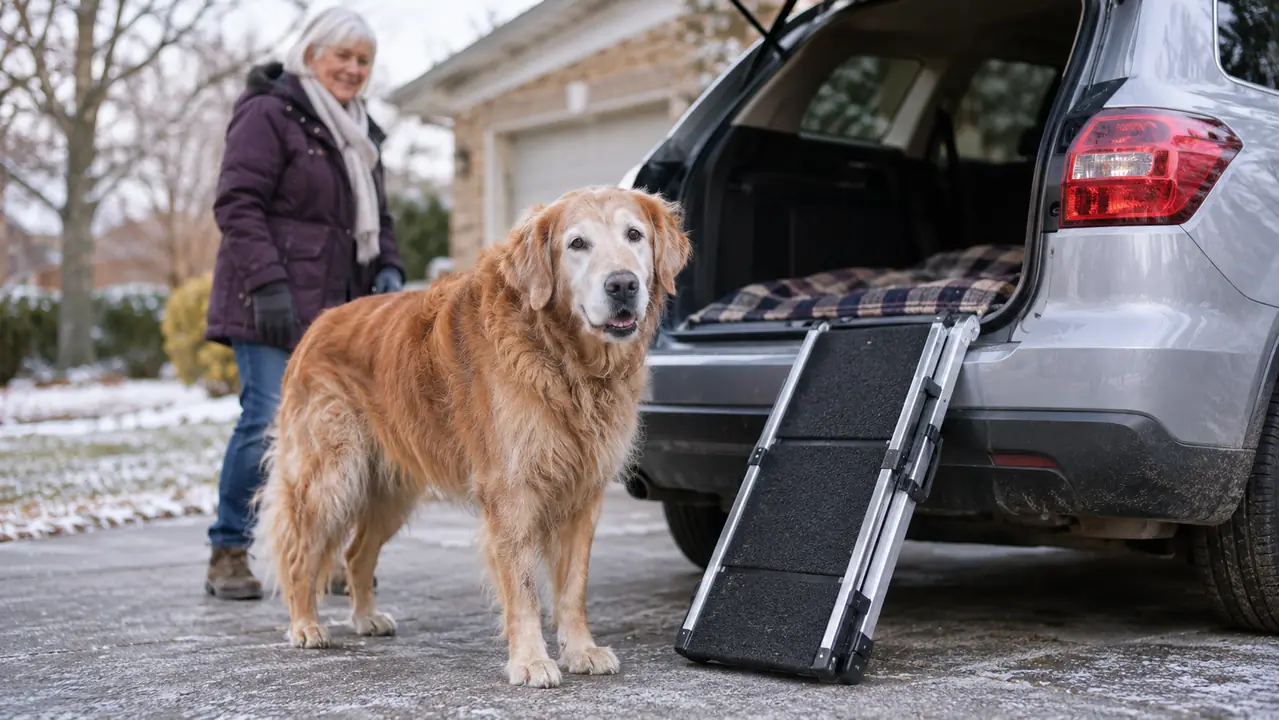
The first time Biscuit refused to get in the back of the CR-V, I told myself he was being stubborn. He is a Golden Retriever. He has never refused anything in his life. Then I watched him try again, get one front paw up, and back away. Our vet had told me two years ago that both hips were arthritic. That afternoon in the driveway was the first time I understood what that actually meant for our daily routine.
I ordered the PetSafe Happy Ride Folding Dog Ramp that week. I am 61, I have a cranky shoulder of my own, and hoisting 72 pounds of very willing Golden Retriever into a car is not something I can keep doing three times a week. Months later, the ramp lives in the back of the CR-V and comes out most days. Some of what I have to say is good. Some of it is the reason I nearly returned it in the first month. None of it is a cure for arthritis, and I want to be clear about that before anything else.
The Quick Verdict
The lightest thing in my garage has carried 72 pounds four or five days a week without a wobble. The angle is steeper than I expected, and I had to learn how to set it up properly.
Amazon Check Today's Price →The ramp that got my dog back in the car
A folding ramp that weighs 10 pounds, carries up to 150 pounds, and has high-traction treads, side rails and rubber feet. Ten seconds to set up. It stays in my cargo area.
Amazon Check Today's Price on Amazon →How I've Used It
I use it four or five days a week. Biscuit still gets his short evening walk around the block, and about three times a week that walk ends at the CR-V instead of the front door, either because we are heading to the park or because I am running errands and would rather not leave him home alone. The ramp comes out, I set the top edge on the cargo floor, and he walks up. From opening the hatch to closing it again is under a minute, and half of that is Biscuit deciding whether he is interested.
The first week was not smooth. He stopped halfway up the first three times and looked back over his shoulder at me. What fixed it was putting a treat on the cargo floor instead of in my hand, so he had a reason to keep moving forward rather than turning around. By day five he was walking up without a pause. By week three he was standing beside the car waiting for me to unfold the thing, which I did not expect and which made me feel a little foolish for waiting so long.
One thing I did not anticipate: I use it on the back deck too. We have three wooden steps down to the yard, and on the mornings when his back legs are stiff, I set the ramp on the steps and he walks down instead of hopping. That is not what the ramp was sold for and it is not a perfect fit on a step, but it has saved him a jarring landing more than once. I always set it myself and I never leave it out there.
The hardest test came on a gray Tuesday in late March, the kind of Dayton morning where the temperature dropped overnight and Biscuit could barely straighten his back legs on the kitchen floor. I had a follow-up appointment at our vet's office and I nearly left him home. Instead I set the ramp on the wet driveway, held the low end down with one foot, and he walked up in one steady push without stopping. That was the morning I stopped thinking of the ramp as a gadget and started thinking of it as part of the car.
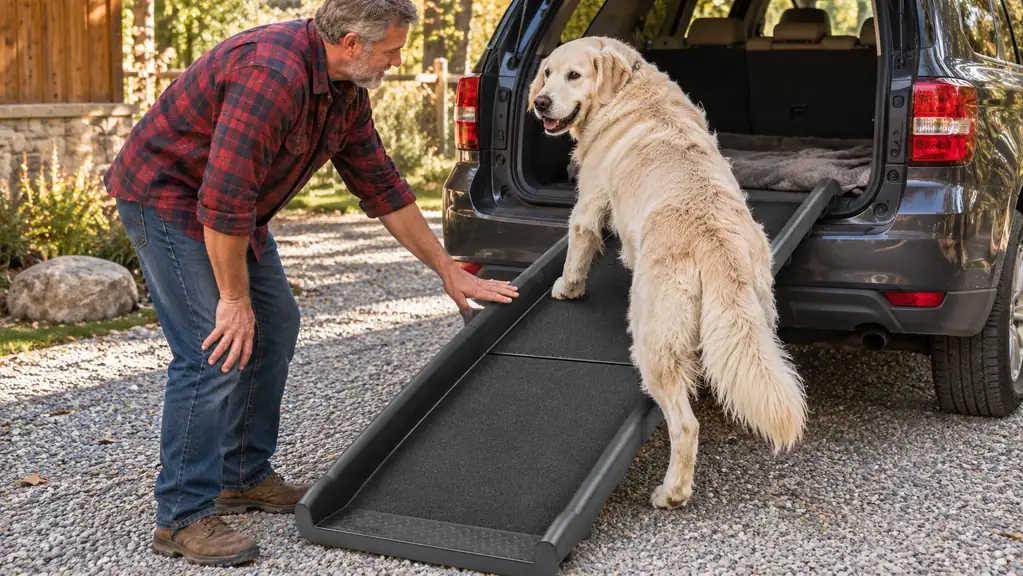
What the Ramp Is, in Plain Numbers
The specs are worth reading plainly, because they tell you what this thing can and cannot do before you spend anything. It weighs 10 pounds. The load capacity is 150 pounds, which gives my 72 pound dog more than double the margin. It measures 62 inches long, 16 inches wide, and 4 inches high, and it folds in half along the middle. The material is plastic and it is made in the United States.
The parts that matter for a dog with bad hips are the high-traction treads, the side rails running along each edge, and the four rubber feet that sit on the ground and on the bumper. There is a safety release latch for the fold. The PetSafe ramp ships with a one year warranty. None of those details are exciting, but a ramp is a piece of equipment, and equipment is judged on whether it stays put.
On that 62 inch length: it is just over five feet, and that number is the one that decides how steep the climb ends up being. It is longer than some car ramps and shorter than others. If your vehicle sits high off the ground, read the next section before you order, because length and bumper height together decide how hard your dog has to work to get in.
The Angle Is the Whole Story
A ramp does not remove the climb. It spreads the climb out over a longer distance. The longer the ramp relative to the height of your cargo floor, the easier the walk. On my CR-V the cargo floor is roughly two feet off the ground, and 62 inches of ramp gives an angle that Biscuit now handles without hesitation. In that first week, before he trusted it, the same angle made him stop halfway. He was not being difficult. He was deciding whether his back legs would hold him.
I measured it, because I wanted a number instead of a feeling. The cargo floor of the CR-V sits at just under 25 inches. With the top edge hooked on the lip and the base of the ramp set back on the pavement, the climb came out somewhere near 25 degrees. I do not know what angle a dog considers comfortable, and no label is going to tell you. What I know is that anything noticeably steeper than what I have is the difference between Biscuit walking up on his own and Biscuit stopping halfway and looking back at me.
If you drive something taller, a full size pickup or a lifted SUV, the same ramp will sit at a steeper angle, and a steeper angle is exactly what a dog with arthritic hips does not want. That is the single biggest limitation here, and no amount of good construction changes it. I would measure your cargo height before ordering and think honestly about whether your dog can manage the climb, because a ramp that is too steep just moves the problem.
The other half of the angle problem is the ground end. On my flat driveway, the rubber feet sit solid and the ramp does not walk. On the sloped apron at the end of my sister's driveway it felt less planted, and I stood with my foot against the low end the whole time. If you park on grass, gravel or a slope, plan to hold it or find flatter ground. That is not a defect. It is the reality of a five foot ramp resting on a surface that is not perfectly level.
Traction and Stability With a 72 Pound Dog
The treads were the part I was most skeptical about, because we live in Ohio and for half the year the dog's paws are wet. Wet paws on smooth plastic is how a ramp turns into a slide. The treads on this one are textured and raised rather than a flat surface with grip tape stuck on, and in the months I have used it, Biscuit has not slipped once. They do collect grit and bits of mulch. I knock it out with a broom every couple of weeks.
The side rails do more than they look like they do. Biscuit is a wide dog and he drifts. The rails give him something to feel at the edge of a paw, low enough that he can see over them and high enough that he can feel them, and on the two occasions he has stumbled, the rail is what kept him from stepping off the side. They will not stop a determined dog from going over. They do give a nervous dog a boundary, and a boundary is most of what settles him.
The rubber feet and the stiffness of the deck are what sold me. Ten pounds of plastic sounds flimsy until you set it down and lean your weight on it. It does not flex under Biscuit, and it has not shifted under him on concrete. I kept a hand on the ramp the first dozen times anyway. I still do when the ground is wet, and I would tell anyone else to do the same.
Going down is a different job and nobody warns you about it. In April we had four days of rain, the driveway stayed slick, and Biscuit came down the ramp faster than he meant to, twice. He did not fall. But a 12 year old dog with sore hips gets pulled downhill by his own weight, and I started walking beside him on the descent with a hand hovering at his shoulder instead of standing at the top watching. That is not a flaw in the ramp. It is arithmetic, and it is worth knowing before your dog teaches you.
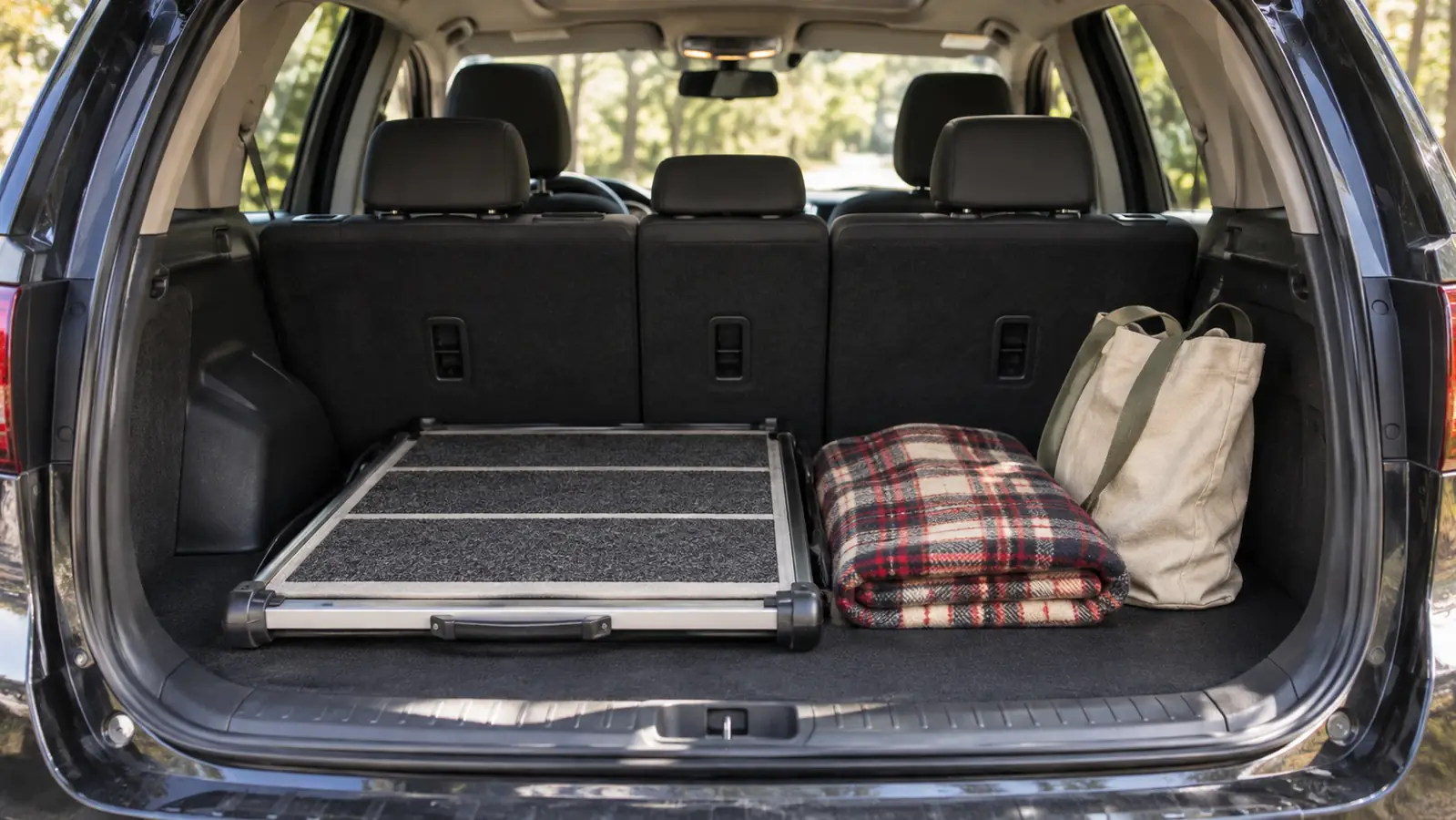
Getting It In and Out, and Where It Lives
It folds in half and lies flat, which means it lives in the cargo area behind the back seat without swallowing the whole space. I keep a folded blanket and a canvas tote back there too and everything fits. Unfolding takes a second, and the safety release latch has not jammed or popped open on its own in months of the ramp sliding around back there on turns.
Storage was what I worried about most before it arrived, because the CR-V is our only car and I use the back for groceries, potting soil, and the occasional bag of mulch. The folded ramp is 4 inches thick and lies flat against the load floor, so the groceries go on top of it. I have never once had to take it out to make room for something else, and I have never once forgotten it was back there until I needed it, which is the highest compliment I can pay a piece of equipment.
The 10 pounds is the right weight. Light enough that I can carry it in one hand with a leash in the other, heavy enough that it does not skate when a dog hits it at an angle. I have carried it from the car to the deck steps and back more times than I can count, and my shoulder has not complained once. That was the entire point of buying it, and it is the part that has held up best.
Cleaning is a hose and a broom. Mud gets into the treads and dries there and it does take a little work to get out. I have not found a crevice that holds water or a hinge that has stiffened up. After a winter of road salt and slush on the driveway, the PetSafe ramp looks used, but nothing has cracked, warped or started to rattle.
What I Liked
- Weighs 10 pounds, light enough to carry one handed alongside a leash
- 150 pound load capacity gives a large dog a wide margin over the 72 pounds it actually carries
- Textured high-traction treads held through wet paws and a wet Ohio spring with no slips
- Side rails give a nervous dog a boundary to feel at the edge of a paw
- Folds in half and stores flat in the cargo area without taking the whole space
- Four rubber feet and a stiff deck, no flex under a 72 pound dog
- Made in the USA and covered by a one year warranty
Where It Falls Short
- Steep angle on taller vehicles, which is the opposite of what an arthritic dog needs
- Length is fixed at 62 inches, so you cannot shorten it to suit a low car
- Treads collect grit, mulch and mud and need regular knocking out
- Less planted on grass, gravel or a slope, best used on flat ground with a hand on it
- A dog that is afraid of the ramp will still be afraid of it, this does not train that
It has not flexed once under 72 pounds and it has not slipped once on wet pavement. For a piece of plastic that folds in half and lives in the back of a car, that is more than I expected.
Who This Is For
This is for the owner of a big dog who has stopped jumping into the car and started doing arithmetic at the tailgate instead. It suits a dog between roughly 50 and 150 pounds with the strength to walk a gentle slope but not the strength to hop. It suits a car or SUV where the cargo floor is around two feet off the ground, which is where 62 inches of ramp lands at a workable angle. It suits someone who can carry 10 pounds in one hand and stand at the bottom holding the ramp steady for fifteen seconds. And it suits someone willing to spend a week teaching the dog what the ramp is before expecting him to use it without a treat.
Who Should Skip It
Skip it if you drive a lifted truck or a tall van, because the angle will work against you and a longer ramp is the honest answer. Skip it if your dog is over 150 pounds. Skip it if your dog panics at being off the ground, since a ramp does not fix fear and a frightened dog on a slope is a fall waiting to happen. Skip it if your dog's back end has gotten weak enough that he needs support rather than a surface to walk on, and talk to your vet about a sling or a plan instead. And skip it if you cannot reliably hold the ramp on uneven ground. Before any of this, have your vet look at the hips. A ramp is a workaround, not a treatment, and it will not do anything for pain or inflammation on its own.
If your dog has started doing the math at the tailgate
Biscuit stopped jumping into the CR-V in February and started walking up a ramp in March. It weighs 10 pounds, carries up to 150 pounds, and has high-traction treads, side rails and rubber feet. Have your vet look at the hips first, then decide.
Amazon Check Today's Price on Amazon →