
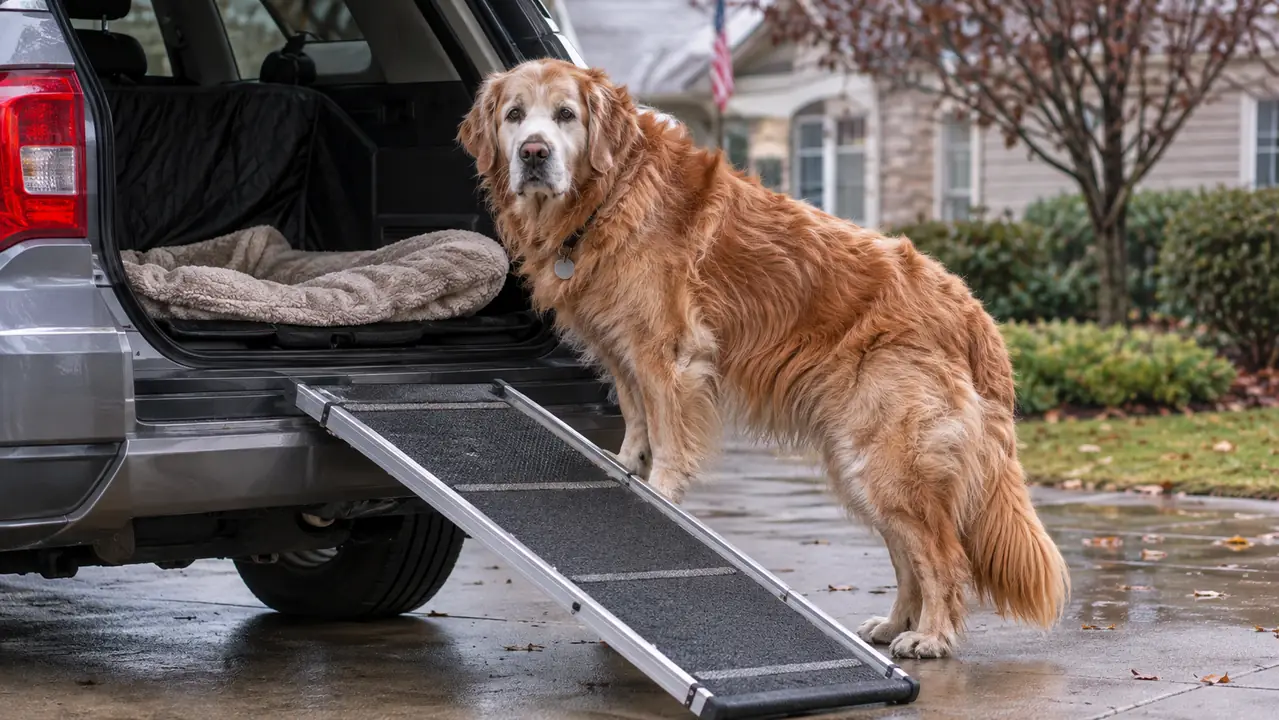
The short answer first, because that is what you came for. For a big dog with sore hips, the PetSafe Happy Ride Folding Dog Ramp is the better buy of the two. Not because it is fancy, and not because it fixes anything. Because it asks the dog to walk up a slope instead of lifting each back leg and planting it four or five times in a row. My Golden Retriever, Biscuit, is 12 and carries about 72 pounds on hips our vet says have been arthritic for roughly two years. He will walk up a slope. He will not, under any circumstances, climb a set of stairs into the back of a car anymore.
That said, I still own a set of dog stairs, and I am not sorry I do. They live by the back deck, where three wooden steps go down to the yard and a 62 inch ramp would be in the way every single time I let the dog out. So this is not a case of one product being good and the other being junk. It is a case of two products doing two different jobs, and most people buying the wrong one because the shelf at the pet store puts them side by side and they look like the same idea.
| PetSafe Happy Ride Folding Dog Ramp | Dog stairs (typical carpeted set) | |
|---|---|---|
| What it asks of the dog | One long walk up a slope, no lifting a hind leg | Lifts each back leg and plants it, four or five times in a row |
| Footprint while in use | 62 inches long and 16 inches wide, so it takes a wide strip of driveway or hallway | Smaller footprint, because it climbs steeply instead of stretching out |
| Grip when dry | High-traction treads, plus side rails so a paw cannot slide off the edge | Carpet holds a paw very well when it is clean and dry |
| Grip when wet | Plastic treads shed water and wipe clean | Carpet soaks up rain and stays damp, which is the worst surface for a slipping dog |
| Carrying it | 10 pounds, folds in half and latches shut | One-piece sets are usually heavier and awkward to carry with one hand |
| Storage in the car | Folds flat and slides in behind the seat of a CR-V | Does not fold, so it tends to live in the garage |
| A tall tailgate or a tall deck | One fixed 62 inch slope, so the higher the lip, the steeper the climb gets | Comes in step counts, so you can match the rise to the height |
| Cleaning | Wipe with a damp rag every couple of weeks | Carpet collects hair, grit, and whatever was on the dog's feet |
| Load rating | Rated to 150 pounds | Varies by set, and the flimsy ones wobble under a big dog |
| Best for | A heavy dog that needs to walk rather than climb | A tight space, or a dog already confident on steps |
How I ended up with both, briefly. Biscuit stopped jumping into the back of our silver CR-V about a year ago, on a wet morning in the fall when the grass was still soaking and I was already running late for a grooming appointment. He stood at the bumper, looked at the cargo floor, looked back at me, and waited. First I tried a set of carpeted stairs a neighbor lent me. On the car they were hopeless. He climbed them twice, refused them for a week, and the third time he tried he caught a back paw on the second tread and stopped trusting the whole arrangement. Then I tried lifting him, twice, and my own lower back registered its objection before he did. Lifting was not something I wanted to repeat, for his back or for mine. The ramp solved the car in one afternoon. It did nothing for the deck, because the deck does not need a 62 inch runway, it needs a dog to take three ordinary steps. So the stairs stayed by the back door and the ramp moved into the car full time.
Where the PetSafe Ramp Wins
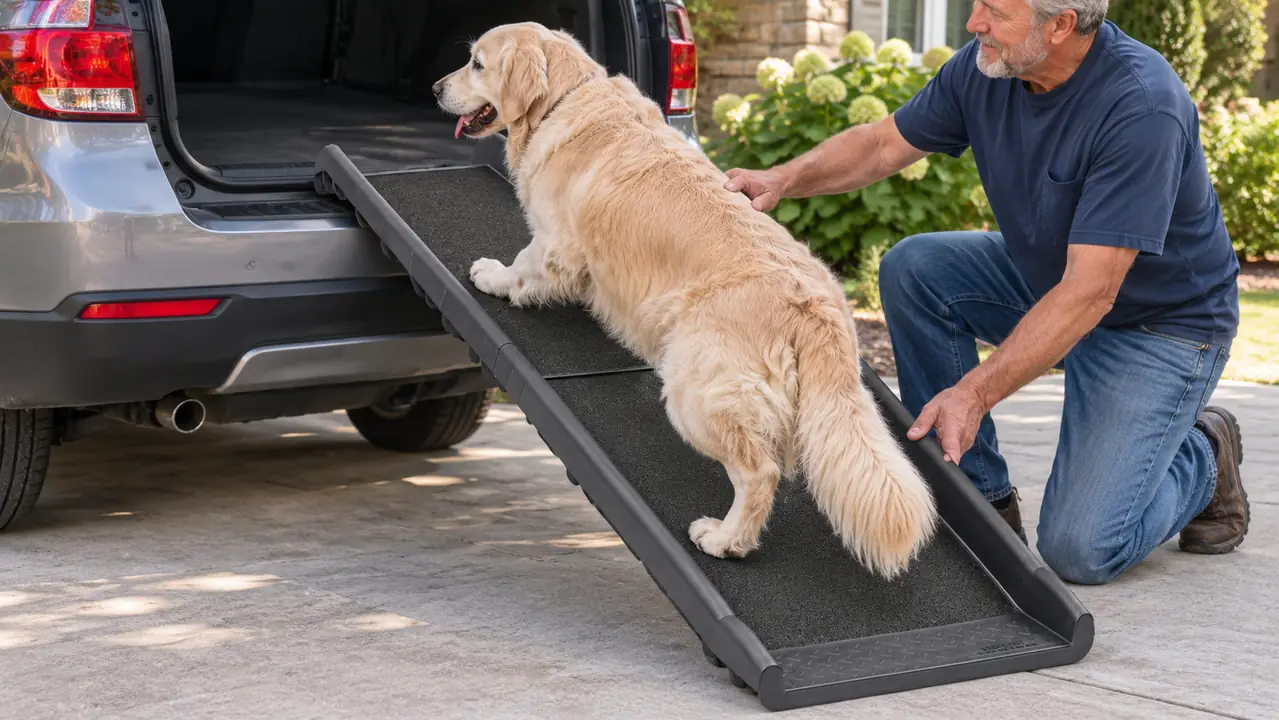
It comes down to the shape of the motion. A ramp is one continuous surface, so a stiff dog can find a rhythm and keep it. Step, step, step, up. Stairs break that rhythm into separate efforts. The dog has to stop, gather himself, lift a hind leg that does not want to lift, find the tread, and then do it again with the other leg. Biscuit manages two steps into the car and then stalls on the third with his back end quivering, and I am not going to stand there and watch that when there is another option. On the ramp he keeps moving. That is the entire argument, and it is the reason I would buy the same ramp again without thinking about it.
The physical details matter more than they sound. The PetSafe ramp is 62 inches long, 16 inches wide, and about 4 inches tall when it is folded. It weighs 10 pounds, which counts for more than you would expect, because you will be carrying it with one hand while holding a leash with the other. It is rated for 150 pounds, so a 72 pound Golden is nowhere near the limit, and I like knowing that on the day he leans sideways. Before I bought it I measured the floor of the CR-V at just under 25 inches off the ground, and against a 62 inch ramp that works out to a slope gentle enough that he does not have to lean into it. On a taller vehicle the same ramp gets steep quickly, which is its own conversation. I also walked up it myself once in my stocking feet, to see what he would be feeling. It flexed less than I expected for 10 pounds of plastic, and it did not skate away from the bumper. The surface has high-traction treads and side rails. I did not think much of the rails until the first wet morning, when one of his back feet slid sideways a few inches and the rail caught his paw and kept him on the ramp.
There are four rubber feet that sit against the pavement so the base does not inch away from the bumper as he loads. There is also a safety release latch that holds the whole thing shut when it is folded, which is the difference between a tidy object in the back of the car and a plastic accordion that comes open the first time you brake hard. It folds in half and latches, and that is the reason it lives in the car instead of the garage. The mobility aid you actually use is the one that stays within reach. I wipe the treads with a damp rag every couple of weeks, more often in winter when road salt gets tracked around. It is plastic, it is not beautiful, and it does not hold grit the way carpet does. It is made in the USA and the warranty is one year.
Where Dog Stairs Win
Stairs win on room, and it is not a small win. A set of carpeted stairs stands nearly upright when it is not in use, so it tucks against a wall in the garage or into a footwell without taking a strip out of the floor. Our driveway is narrow and I park close to the house, and there were a few weeks when the ramp made getting the groceries in genuinely annoying. My neighbor keeps a set of stairs behind her front door for her nine-year-old Labrador and has never needed a ramp, because her car sits low and her steps are short. If your dog has used stairs comfortably for years and still does, do not fix what is working.
Stairs also handle height better at the top end. A ramp is a fixed 62 inch slope, so the higher the surface you are aiming at, the steeper the climb becomes. Against a low car or a single porch step, that is easy for an older dog. Against a tall truck tailgate, the same ramp turns into a climb that a stiff dog may refuse, and you will find yourself shopping for a longer ramp instead. I found that out in April at the garden center, when a friend's pickup sat high enough that my ramp looked more like a slide than a path, and I did not even take it out of the car. There was no version of that climb Biscuit was going to agree to. Stairs come in step counts, so a taller deck or a lifted vehicle can get an extra step and keep the rise per step gentle. Our own deck is the plainest example: three low wooden rises down to the yard, nothing like the drop from a tailgate, and he takes them without a thought.
The catch is the surface. Carpet is lovely under a paw on a dry Tuesday and miserable in February. It holds rain, it holds road salt, it holds hair, and once it is damp it stays damp. I have watched a dog slip on wet carpeted stairs in a way he never slipped on the wet treads of the ramp. The cheap sets also flex, and a flexing step under a 70 pound dog is worse than no step at all, because it teaches him the ground is not trustworthy. If you go with stairs for a big dog, buy a set that does not move when he does.
If your dog stalls at the bumper, start here
The PetSafe Happy Ride Folding Dog Ramp is 62 inches of continuous slope, 10 pounds, rated to 150 pounds, with high-traction treads, side rails, and four rubber feet. It folds flat and latches, so it stays in the car where you need it.
Amazon Check Today's Price on Amazon →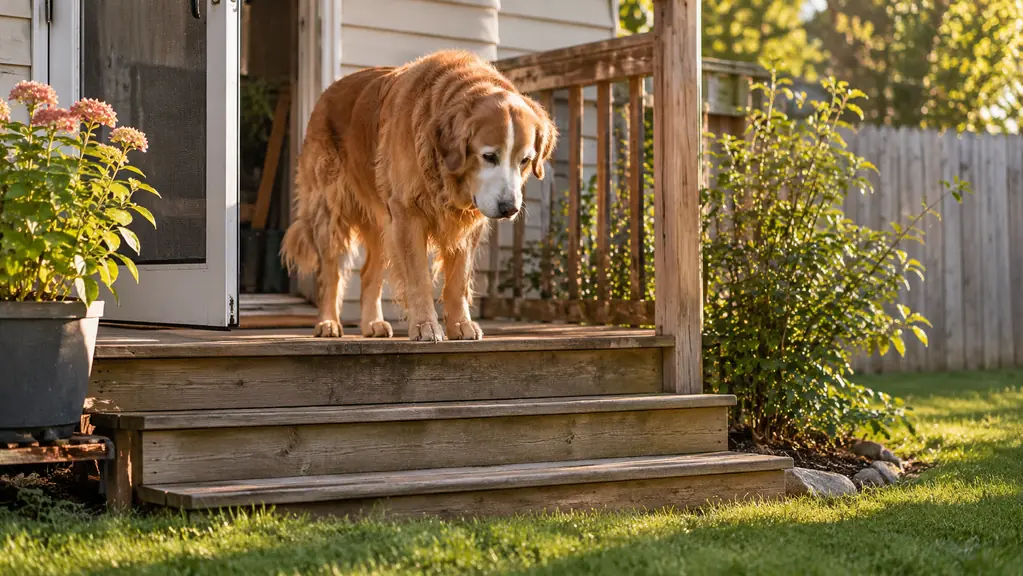
What Neither One Fixes
A ramp is a workaround, not a treatment. It does not make an arthritic hip better. It keeps Biscuit from doing the one motion that hurts most, which is a different thing from fixing what hurts, and I think it is important to say that plainly. Our vet was clear with me about it two years ago: keep him lean, keep him moving on the flat, keep his nails short so his feet land properly, and check in before you change anything about his routine or add anything to his food. One useful thing she added was that a ramp does not replace a walk. Biscuit's evening loop around the block, four houses down and four houses back, does more for those hips than anything hanging in my garage, and on the cold mornings when he would rather stay on his bed, I take him out anyway and let him set the pace. Ten slow minutes at his speed beats an hour of me coaxing. If your dog is newly stiff, that vet conversation comes before any purchase, mine included. A ramp bought in place of a diagnosis is just a ramp.
The other thing neither product fixes is the dog's opinion. Biscuit refused the ramp for the first three days. He stood at the bottom and looked at it like it had said something rude. What worked was putting a few pieces of his regular kibble on the lower treads and letting him figure out that his feet stayed under him. I did not push, I did not lift him onto it, and I did not make it a project. By the fourth day he walked up it because the car was at the top and the car means a ride. If your dog is anxious rather than sore, expect a week, not an afternoon, and consider asking your vet about a handler or a trainer who works with older dogs.
Who Should Buy Which
Buy the ramp if your dog is big, if he is stiff in the back end, and if the thing he has stopped doing is getting into a vehicle. That is the job the PetSafe ramp was built for and the job it does well. It also suits a dog who has started hesitating at a single high step, like a porch or a truck bed, where you can set the base on the ground and give him a slope instead. And it suits anyone who has already tried lifting a 70 pound dog and would prefer never to do it again.
Buy the stairs if your dog is small, if your space is tight, if your vehicle sits low, or if the height you are dealing with is tall enough that a 62 inch slope would be steep. Buy them if your dog already climbs steps without a second thought and simply needs a set that does not wobble. And if you are honestly not sure which camp you are in, watch your dog at the bumper for a week. A dog who lifts a leg and stalls is telling you he needs a slope. A dog who trots up three steps and waits for you at the top is telling you he is fine, and you can save the money for his next vet visit.
For us, it was never either or. The ramp handles the car, the stairs handle the deck, and the dog handles the flat ground at his own pace, which at 12 years old is slower than it used to be and still the best part of my evening.
The one that lives in the car
Ten pounds. Folds to about 4 inches and latches shut. Rated to 150 pounds, with treads and side rails for wet mornings. If your dog waits at the bumper instead of jumping in, this is the one to try first.
Amazon Check Today's Price on Amazon →