
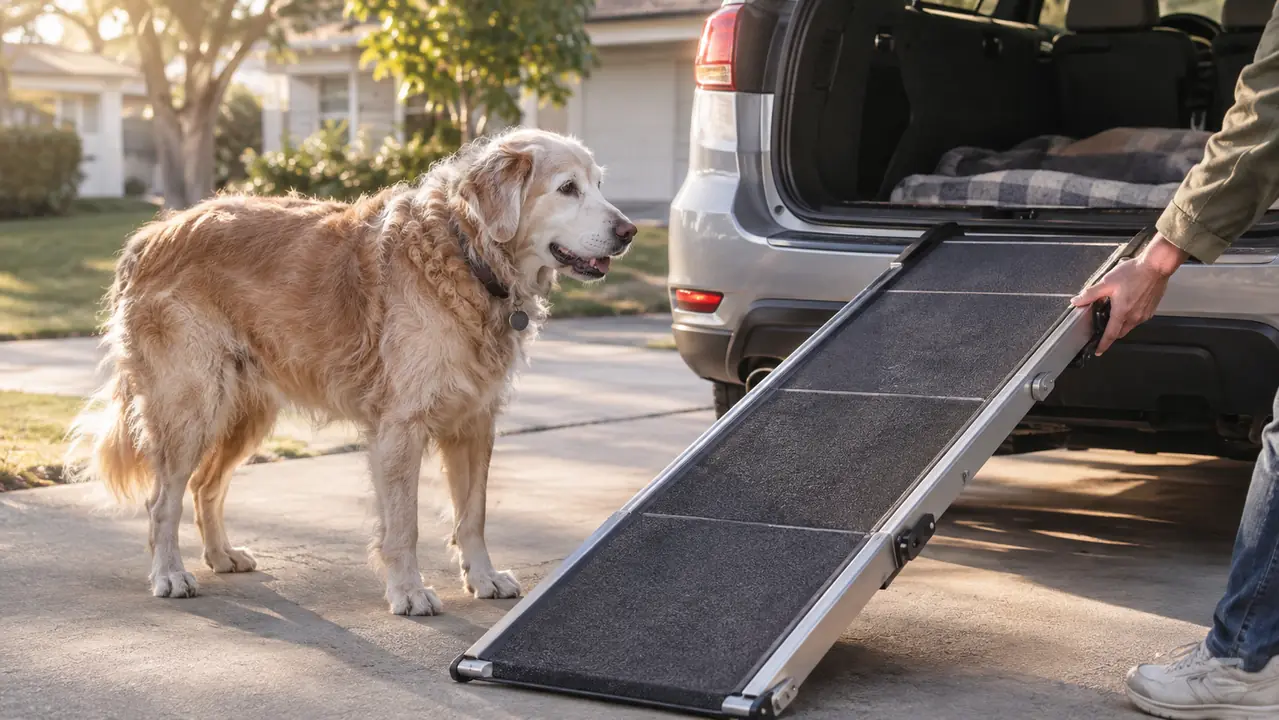
The first thing nobody tells you about a dog ramp is that it does not fix the car by itself. It fixes the angle. That sounds like a small distinction until you are standing in a driveway at 7:10 in the morning with a 72-pound Golden Retriever who has decided the back of a silver Honda CR-V is now a cliff. Biscuit is 12. Our vet diagnosed arthritis in both hips about two years ago, and the stiffness in his back legs is worst on cold Dayton mornings. I bought the PetSafe Happy Ride Folding Dog Ramp because I needed a tool, not a promise. What follows is the honest version, including the parts I would want a neighbor to tell me before I unfolded one in my own driveway.
I am not a veterinarian and this is not a treatment plan. It is a report from daily use. Biscuit still takes his short evening walk around the block. He still wants to go. The problem was loading and unloading, and the back deck with three wooden steps down to the yard. The ramp did not cure his hips. It changed how he gets from point A to point B, and it removed one daily struggle that was making both of us dread the car. That is a smaller claim than most ads make. It is also the only claim I can defend after living with the thing.
The Quick Verdict
A genuinely useful folding ramp for a 72-pound senior dog and a CR-V, with real caveats about width, training, and tight parking spaces. Buy it for the angle, not for a cure.
Amazon Check Today's Price →If your dog has started refusing the jump, fix the angle before the jump gets higher
The PetSafe Happy Ride Folding Dog Ramp is the version I kept in the CR-V: 10 pounds, bi-fold, 150-pound load capacity, and high-traction treads. It still takes two weeks of practice. Start on a flat driveway, not at the tailgate.
Amazon Check Today's Price on Amazon →How I've Used It With Biscuit
I keep the ramp folded in the back of the CR-V. Folded, it is 62 inches long, 16 inches wide, and 4 inches high, and it weighs 10 pounds. That is light enough for me to pull out with one hand at 61, but long enough that I have to think about where I park. I set it against the tailgate lip, check that the rubber feet are flat on the driveway, and make sure the safety release latch is seated. Then I put Biscuit's leash on and let him look at it. The first five times, looking was most of the job.
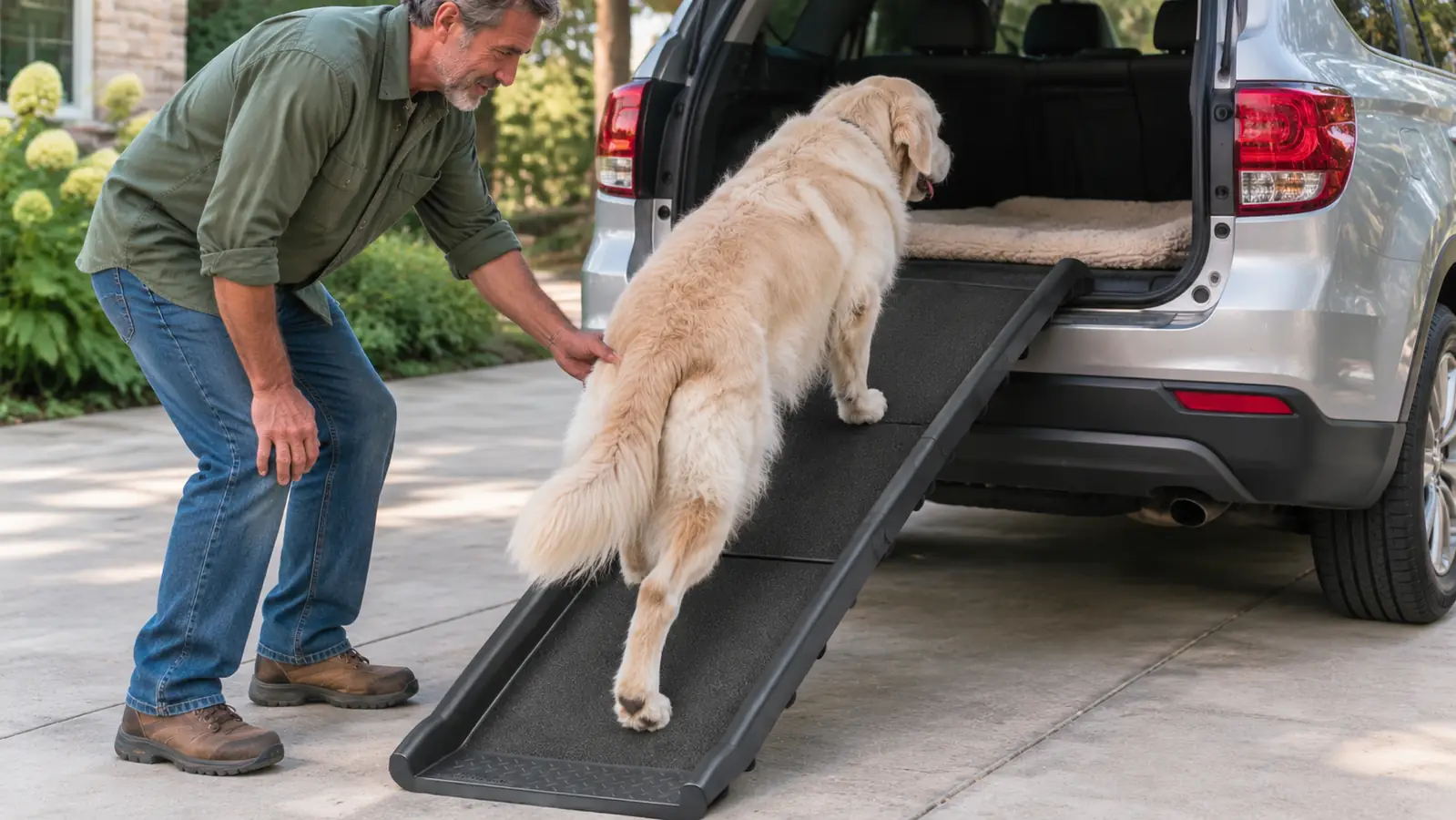
Biscuit is 72 pounds. The ramp is rated for 150 pounds, so he is well inside the limit. I still walk beside him with my hand near the side rail, not because the ramp flexed under him, but because he is old and proud and sometimes tries to turn around halfway up. The high-traction treads give him something to grip. The side rails give me a place to guide him without grabbing his collar. The rubber feet kept the base from sliding on my concrete driveway. On the tailgate lip, the ramp sits and waits for him to commit.
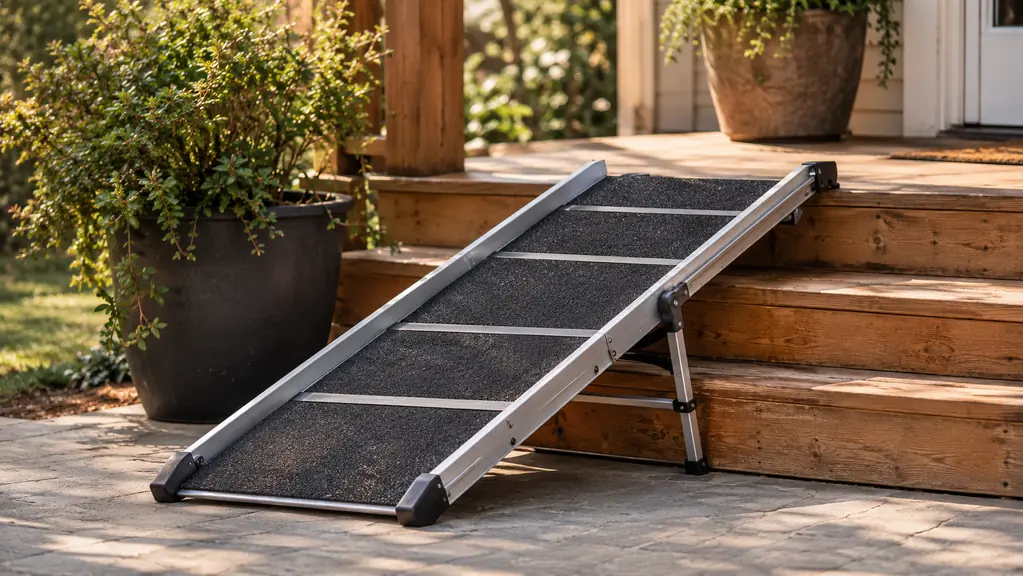
The back deck was a different story. We have three wooden steps down to the yard, and I tried the ramp there once. It is 62 inches long. On a short deck, that length eats up the landing space, and the angle was not better than the steps for Biscuit. I went back to the car only. That is the kind of thing I wish someone had told me: a ramp is not a universal staircase replacement. It is a vehicle-loading tool that can work on some deck setups if you have the room and a secure lip. We did not.
What the Ramp Gets Right
The best thing about the PetSafe ramp is that it makes the height of the CR-V gradual instead of sudden. Biscuit can no longer jump into the back on his own. He used to do it with a little hop and a wince. Now he walks up a slope. The ramp does not lower the vehicle. It spreads the climb over 62 inches, and that is enough to change his willingness. On a cold morning, willingness is most of the battle.
The build is simple in a way I appreciate. It is plastic, it folds in half, and it has four rubber feet, side rails, high-traction treads, and a safety release latch. The load capacity is 150 pounds. The listing says it is made in the USA. I have not weighed it myself, but the 10-pound figure feels right when I lift it out. It is not a piece of furniture. It is a portable tool, and it behaves like one.
The treads are the part that matters most. Biscuit's back legs are stiff, and a smooth surface would make him hesitate. The high-traction treads give his paws something to push against. The side rails are low, but they are enough to give him a visual boundary. The rubber feet keep the base from walking away on concrete. I check all four every time, because a ramp that shifts is worse than no ramp. So far, they have stayed put.
What Nobody Tells You About the First Two Weeks
A ramp is a new piece of furniture to a dog. Biscuit did not understand it. He stood at the bottom and looked at me like I had set a trap. The first attempt, he put one paw on and backed off. The second day, he made it halfway and turned around. The third day, he walked up with a trail of tiny treat pieces and a lot of praise. If you expect your dog to use it on day one because it is supposed to help, you will both be frustrated. This is a training project.
The noise is another thing nobody mentions. The ramp is plastic, and when it settles against the tailgate lip, it can clack. Biscuit is noise-sensitive. The first few times, the clack was enough to make him stop. I started setting the ramp in place before I brought him out, so he did not have to watch me unfold it. That one change helped more than any treat. If your dog is sound-sensitive, do the setup first, then bring the dog.
Parking matters more than I expected. You need room behind the vehicle for a 62-inch ramp plus a dog. In a tight lot, that is not always possible. I now park farther out, where I can open the tailgate and lay the ramp on a flat surface. If you live in a city and park on a slope, practice somewhere flat first. The rubber feet help, but they cannot make a bad angle good. A ramp is only as steady as the ground under it.
The Parts That Frustrate Me
The width is 16 inches. Biscuit is 72 pounds and he fits, but there is not a lot of room for error. A nervous dog who looks sideways can put a paw over the edge. The side rails help, but they are not walls. I walk beside him for that reason. If you have a dog who panics, or a dog much wider than a Golden Retriever, measure first and think about whether a wider ramp would be kinder. Sixteen inches is fine for Biscuit. It is not a runway.
Folded, the ramp is 4 inches high and 10 pounds, but it is still 62 inches long. That means it takes up real space in the back of the CR-V. It is not a small item you can tuck under a seat. I keep it in the cargo area, and I notice it when I load groceries. That is the tradeoff for a ramp long enough to make a gentle angle. A shorter ramp would fit better and be steeper. I would rather have the length.
The warranty language on the listing is confusing. One part mentions a one-year warranty, and the included components mention a lifetime warranty. I cannot tell you which applies to your order today. I can tell you to keep your receipt and check the current terms before you rely on either. That is not a reason to skip the ramp. It is a reason to be a careful buyer. I would rather say that plainly than pretend the paperwork is clearer than it is.
A ramp does not make a tall vehicle low. It makes the climb gradual, which is the only thing my dog actually needed.
Where It Fits in a Senior Dog Routine
We use the ramp for car rides, not for the carpeted staircase inside the house. Biscuit still manages the stairs with a slow, careful rhythm, and our vet has not told us to stop. If your dog is at the point of falling on stairs, that is a conversation for your vet, not a product page. For us, the ramp is about the CR-V. It is also about not lifting 72 pounds of reluctant dog into the back seat, which was hurting my back and making him anxious.
The routine is simple. I park, set the ramp, check the feet and latch, then bring Biscuit out on the leash. He gets a small treat at the bottom and another at the top. I do not rush him. On cold mornings, I give him a minute to loosen up before we start. On the way home, I do the same thing in reverse. The ramp has made our vet visits and our short drives less of a production. That is the whole benefit. It is not glamorous. It is just easier.
I also use a towel on the back seat for grip and cleanup, but that is not part of the PetSafe system. It is just something I already had. The ramp itself has high-traction treads, and that is the part that matters. I check the treads for mud and leaves before we load. A slick tread defeats the purpose. A quick wipe with a damp cloth is enough. This is not a high-maintenance item, but it is not a leave-it-and-forget-it item either.
How It Has Held Up
After a spring and summer of steady use, the ramp still folds and unfolds without drama. The fold still sits flush. The safety release latch still catches. The rubber feet are still attached, and the treads have not smoothed out. There are scuffs on the plastic from the driveway and the tailgate lip. That is normal. I do not expect a plastic ramp to look new forever. I expect it to be steady, and it has been.
The one thing I watch is the tailgate lip. The ramp rests there, and if the lip is curved or wet, I take extra care. The safety release latch is meant to keep the ramp from folding accidentally, but it does not clamp the ramp to the car. You still have to set it correctly. I check it with my hand before Biscuit steps on. That habit takes five seconds. It is the difference between a tool and a hazard.
I have not had a failure. I have had close calls with placement, which is a different thing. The ramp slid once on a smooth garage floor before I reset the rubber feet. That was my error, not the ramp's. On concrete and asphalt, it has been stable. On a slippery surface, you need to be more careful. I would not use it on ice. I would not use it on a steep slope. I would not leave a dog unattended on it. Those are not product flaws. They are the limits of a portable ramp.
What I Liked
- Weighs 10 pounds and folds in half, so one person can move it.
- Rated for 150 pounds, which is plenty for a 72-pound dog.
- High-traction treads, side rails, and four rubber feet give a senior dog clear footing.
- 62-inch length makes the climb into a CR-V gradual instead of a jump.
- Safety release latch and simple plastic build are easy to check before each use.
Where It Falls Short
- 16-inch width leaves little room for a dog who panics or drifts sideways.
- 62-inch length needs real space behind the vehicle and takes up cargo room.
- Plastic can clack against the tailgate, which spooks sound-sensitive dogs.
- Not a substitute for stairs inside the house or for a secure deck setup.
- Warranty language on the listing is inconsistent, so keep your receipt.
Who This Is For
This is for the owner of a mid-size to large senior dog who can still walk but should not jump. It is for a car, SUV, van, or truck with a tailgate or cargo opening where you can set a 62-inch ramp on flat ground. It is for someone willing to spend a week or two training with treats and patience. It is for a dog like Biscuit, 72 pounds, arthritic hips, still interested in the evening walk, and no longer willing to hop into the back of a CR-V. If that sounds like your house, the PetSafe ramp is a practical tool.
It is also for the person who is tired of lifting. I am 61. Lifting a 72-pound dog is not a long-term plan for my back or his dignity. The ramp lets him do the work at his own pace. That is the part I value most. It is not about making him young again. It is about keeping the car trips possible without a struggle. If your vet has cleared your dog for walking and you just need a safer way to load, this is the gap the ramp fills.
Who Should Skip It
Skip it if your dog is falling, dragging a leg, or in pain that is not managed. That is a vet conversation first. Skip it if you have a dog who panics at plastic noises and you are not prepared to train slowly. Skip it if your vehicle is so tall that a 62-inch ramp still creates a steep angle, or if you cannot park with room behind the car. Skip it if you need a ramp for a narrow hallway or a short deck with no landing space. And skip it if you want a permanent solution for stairs inside the house. This is a portable vehicle ramp, not a home modification.
I would also skip it if you are not going to check the rubber feet and the latch every time. A ramp is only as safe as its placement. That sounds obvious, but I have seen people set a ramp on gravel and walk away. I have also done it on a smooth garage floor and had to reset it. The PetSafe ramp is stable when it is set correctly. It is not foolproof. No ramp is. If you want something that requires zero setup, this is not that.
The honest version: buy the ramp for the angle, then budget two weeks to teach the dog
If Biscuit can learn it at 12, most willing senior dogs can. Set it on flat ground, check the four rubber feet and the safety release latch, and keep the first sessions short. The PetSafe Happy Ride Folding Dog Ramp is the one I still keep in the CR-V.
Amazon Check Today's Price on Amazon →